How to Stop Doing Everything Yourself in Your Business?

The essentials: If your business stops when you stop, it does not belong to you: it employs you. The way out: make your role replaceable, one task at a time, by documenting, delegating, and automating.
What you will learn:
- How to diagnose your bottleneck with the 3-Day Test
- How to identify the tasks to delegate, automate, or eliminate, in order
- How to document your processes in a few hours
- How to delegate without losing control or quality
Before you continue: This article is for owners of small businesses with 1 to 9 employees who carry everything: quotes, invoices, bookkeeping, follow-ups, production. If you run a mid-sized company with a managed team, you will still find the method useful, but your priorities will differ. If you just launched your activity and everything still rests on you, this is the right moment: the earlier you build the system, the less painful the way out will be.
This is a question I receive almost every week, in meetings or by email: “Thomas, I do everything in my company. I know it cannot last, but I do not see how to do it differently.”
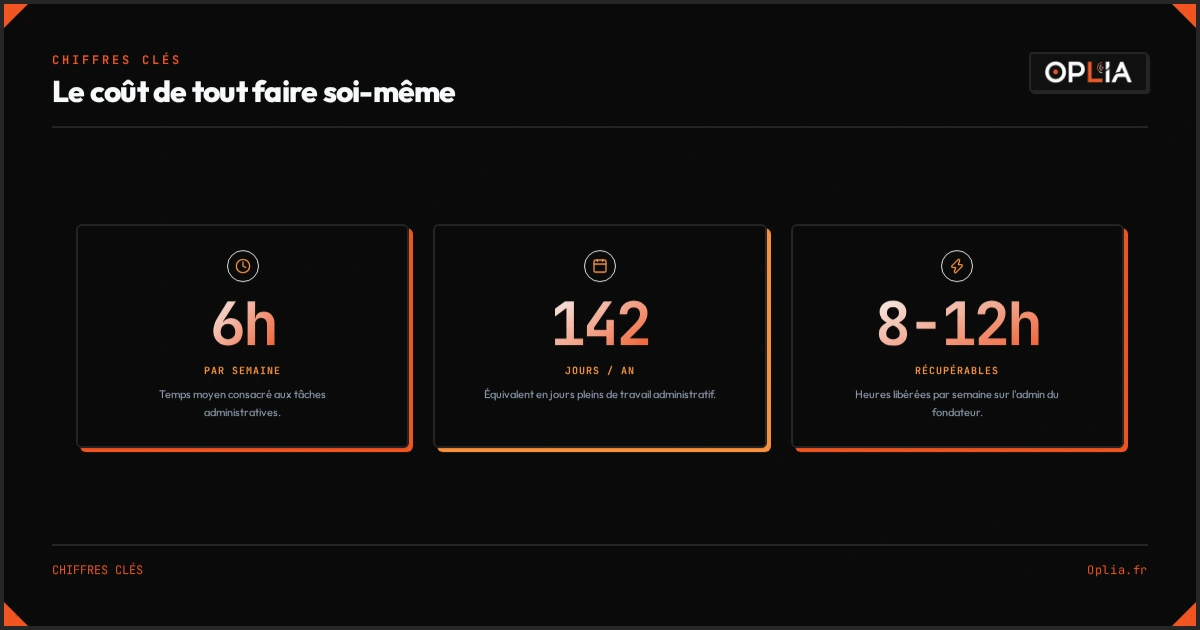
The small business owner spends on average 6 hours per week on administrative tasks, invoicing included. That is 142 days per year, according to a Sage study cited by Qonto. And the SDI survey is even harsher: only 8% of self-employed people say their administrative burden has lightened in five years.
The problem: you are the bottleneck of your business. Everything goes through you, everything waits for you, and the business caps out at your personal capacity.
The solution: a four-step method, tested in the field, to get tasks out of your head one by one. Twelve minutes of reading, and you leave with a plan for the week.
Table of contents
- Why Is It So Hard to Stop Doing Everything Yourself When You Run a Small Business?
- How Do I Know If I Am the Bottleneck of My Business?
- Which Tasks Should You Stop Doing First?
- How Do I Document My Processes Without Spending Weeks on It?
- How Do I Delegate Without Losing Control or Quality?
- What Can Automation Really Remove From My Workload?
- Where Should I Start This Week to Stop Being Indispensable?
- Key Takeaways
- Going Further
Why Is It So Hard to Stop Doing Everything Yourself When You Run a Small Business?
The cause is rarely technical: it is fear and habit.
Fear first: if I delegate, I lose control. If I show how I do things, I become replaceable. If someone does it wrong, I am the one who answers to the client. This reasoning is understandable. It is also ruinous, because it condemns the business to your size.
Habit next: when you have done everything yourself for years, delegating takes more effort at the beginning than continuing. Documenting a procedure takes 30 minutes. Doing it yourself takes 10 minutes. The math is wrong over the week, but it is the math our brain does every time.
A study from the CPME, 2025 activity report, shows that 47% of small business owners spend at least two days a week on administrative tasks. Two days. Out of five. Meanwhile, the competitor who structured their organization is prospecting, developing, and answering clients.
“Most businesses fail because their founders work in their business instead of on their business.” — Michael Gerber, author of “The E-Myth Revisited” (HarperBusiness, 1995)
This quote is thirty years old and has not aged a day. Working on the business means building the machine that runs without you.
How Do I Know If I Am the Bottleneck of My Business?
Take the 3-Day Test: cut everything off for 72 hours, without warning anyone, and write down what stops.
No need to actually do it. Simulate it mentally, or test it over a long weekend. The list of what blocks gives you your level of dependency.
A metal workshop owner actually did the experiment, and told the story on the Reddit forum r/smallbusiness. He was away for five days with no contact. His company did not last three days: a change in client specifications went unmanaged, a supplier invoice had no validated purchase order. His conclusion, cited by the Oplia wiki: for half of the critical operations, he was the process. Not because his team was incompetent, but because he had never written anything down (a lived testimony shared on Reddit, to be taken as indicative: link).
Here are the objective signs of a bottleneck:
| Signal | What it reveals |
|---|---|
| You validate every quote, every invoice, every expense | No decision delegation exists |
| Clients and team wait for your return to move forward | Procedures are not written down |
| Your vacations turn into remote work | You do not trust what runs without you |
| No one can do certain tasks except you | The knowledge is in your head, not in the business |
| You have been working more than 50 hours a week for months | The load never decreases, it accumulates |
What this means for you: if three of these signals apply to you, your problem is not a team problem. It is a system problem.
Which Tasks Should You Stop Doing First?
The ones that are repetitive, frequent, and follow a procedure. That is the only criterion that matters.
A task has two dimensions: its value (what it brings in) and its repetitiveness (how many times a week you do it). The trap is sorting by value. A signed quote has enormous value, so you keep it. Except the quote follow-up has no value: it follows a script, and 80% of sales happen after several follow-ups.
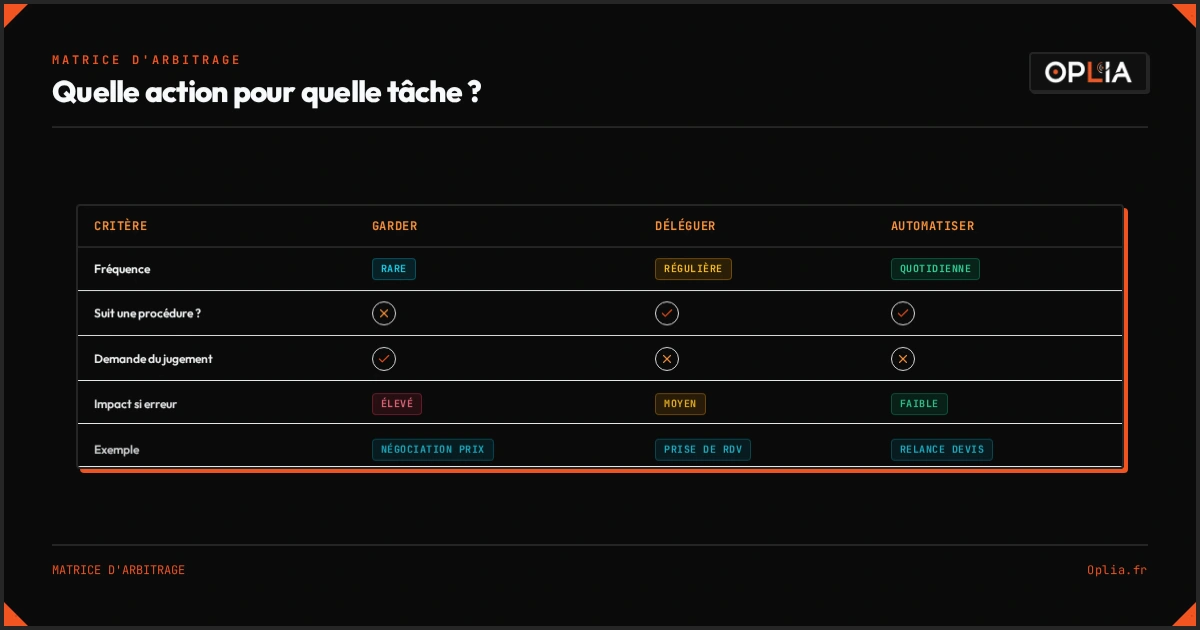
| Task type | Examples | Action |
|---|---|---|
| Repetitive + procedural | Quote follow-ups, invoicing, bookkeeping entry, bank reconciliation | Automate |
| Repetitive + transferable | Appointment scheduling, weekly reporting, routine supplier management | Delegate |
| Rare + strategic | Price negotiation, hiring, launching an offer | Keep for yourself |
| No added value | Tasks done “because we have always done them that way” | Eliminate |
The most cited experience on this topic comes from an automation professional who has worked on more than 30 business projects: five categories of tasks come up systematically, and the founder’s administrative management alone represents 8 to 12 recoverable hours per week (shared on Reddit r/automation). Eight to twelve hours. That is a day and a half of work, every week, that requires no judgment.
What this means for you: do not look for the perfect task. Take the most repetitive one in your week and handle it first.
How Do I Document My Processes Without Spending Weeks on It?
By aiming for 20 processes maximum, not 200, with a simple format, and by documenting on the fly.
The workshop owner from earlier launched a six-month project to formalize all his processes. Good news: you do not need that. Documentation exists to make a task transferable. It does not exist to decorate a shelf.
The lightweight method, in three rules:
- One document per critical process. No giant knowledge base. One file per task that no one else knows how to do.
- The “5-line” format: when it triggers, who does what, with which tool, what expected result, what to do if it gets stuck. If you cannot describe the task in 5 lines, you do not understand it well enough to delegate it.
- Document while you do. The next time you do the task, write down the steps as you execute them. Ten minutes of notes along the way beat one hour of writing from scratch.
Start with the five processes that stress you the most: the ones you would do at any time in an emergency, the ones no one else even knows exist. A documented process is a task that can leave your head without breaking anything.
What I learned in the field: When I launched Oplia, I did everything myself, research, prospecting, follow-ups, bookkeeping. The turning point was the day I timed my week: two hours of browsing for research, three hours of manual follow-ups. I documented what I did, then I handed research and follow-ups over to automations. Today, in the morning, I find the research ready to read and the follow-ups go out on their own. Research time went from two hours to fifteen minutes a day, and follow-ups go out without me touching them. I no longer do the tasks, I supervise the systems.
How Do I Delegate Without Losing Control or Quality?
By delegating in stages, with a clear objective and a weekly control point. Control is not lost when you delegate. It is lost when you delegate without a framework.
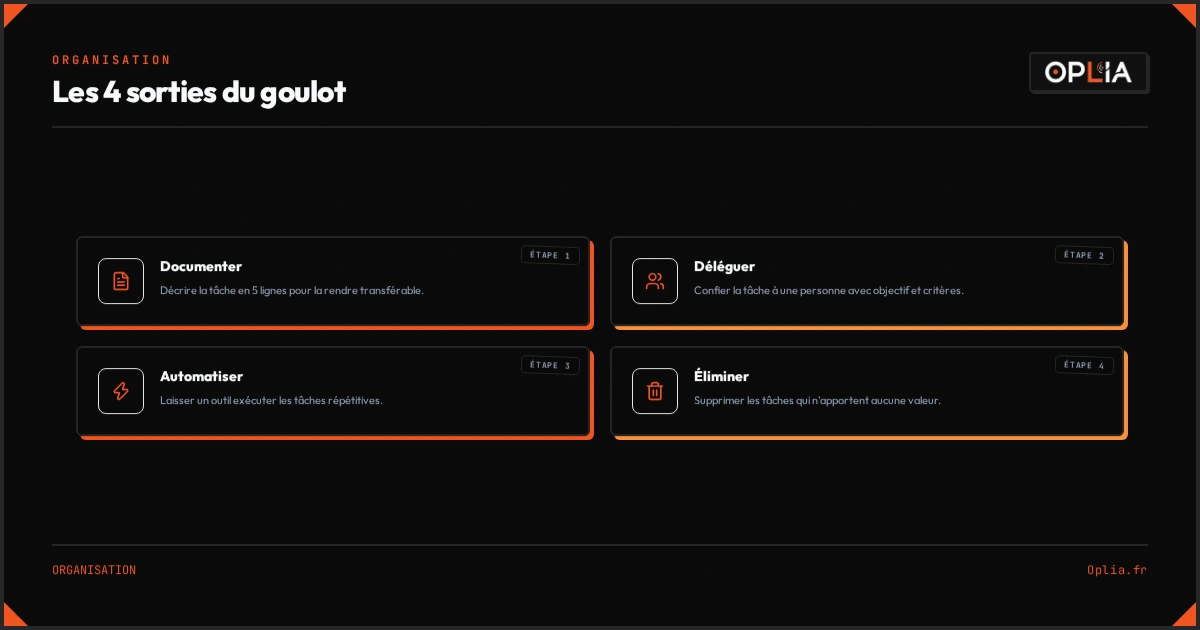
Graduated delegation, in five steps:
- Write the procedure in 5 lines (the documentation from the previous step)
- Set a precise objective and success criteria: “follow up on every unanswered quote within 48 hours”, rather than “handle the follow-ups”
- Give the means: access, budget, tools, decision rights up to a certain amount
- Choose the person or the provider, and test over a defined period
- Set up a weekly control point limited to 30 minutes
The biggest obstacle is not financial. It is the belief that no one will do it as well as you. That is often true for the first two weeks. It is rarely true after two months, because the person does the task continuously while you run the business.
An entrepreneur who built his company so it runs without him explains it simply, again on Reddit r/smallbusiness: the freest owners he knows work 10 to 14 hours a week, because they hired and delegated to buy back their freedom (a lived testimony, indicative: link). The appearance of laziness hides a strategic choice: the business became an asset that generates income without demanding your daily presence.
If what blocks you is specifically your website and your marketing, I wrote a dedicated guide: how to delegate your website and marketing without losing control.
What Can Automation Really Remove From My Workload?
The repetitive tasks that follow a script: follow-ups, invoicing, data entry, notifications. And in 9 cases out of 10, you do not need complicated artificial intelligence, just a well-defined process.
That is the finding of people who have automated for businesses for years: 90% of needs are covered by simple automations that run a predefined process, rather than by autonomous agents (shared on Reddit r/automation). So the question is not “which AI?”. The question is “which process?”.
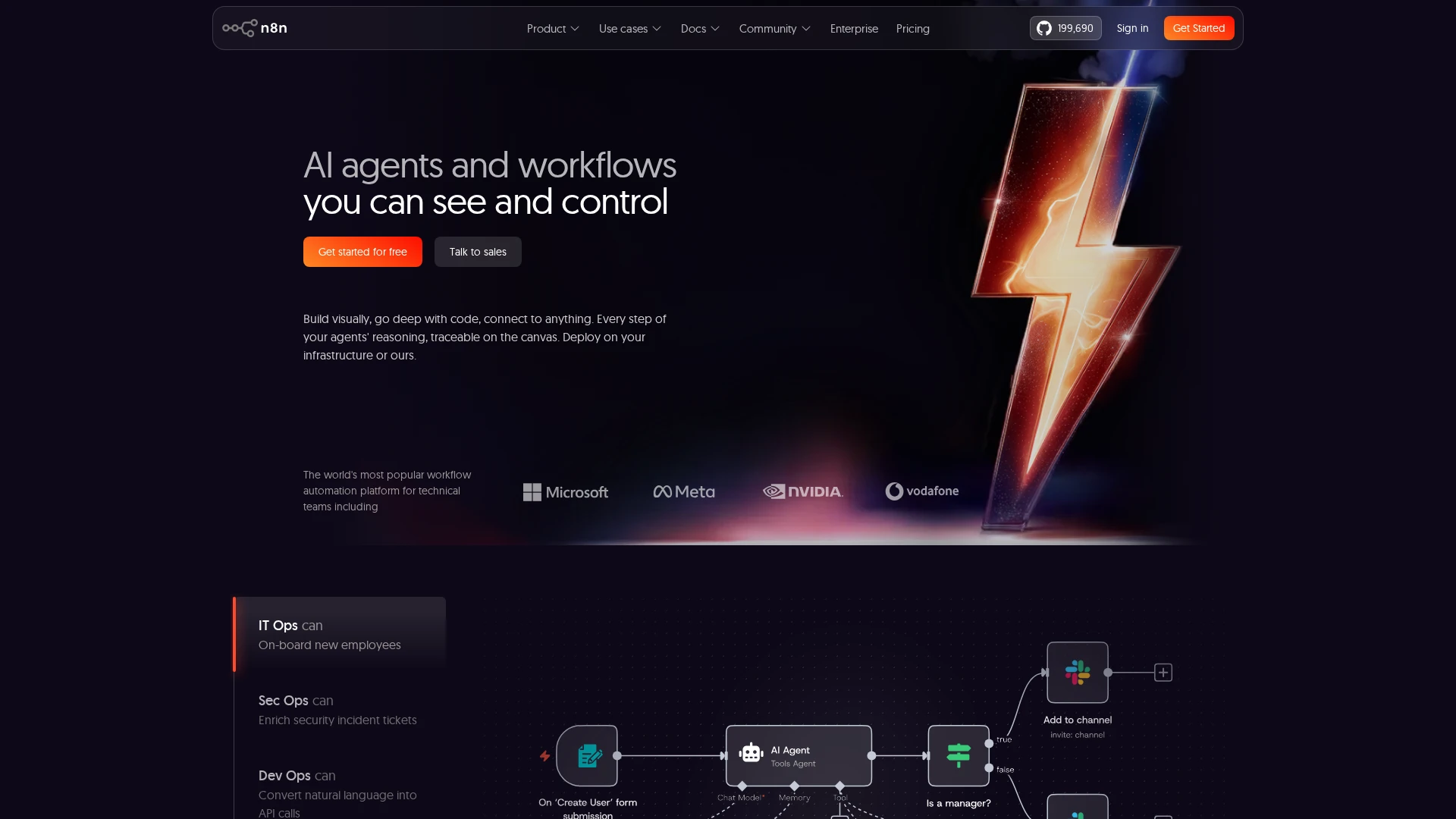
Take the most profitable example for a small business: quote follow-ups. A quote sent without follow-up has little chance of closing. An automation tool like n8n can detect an unanswered quote after 7 days, send a follow-up, then a second one at 14 days with a different angle, and notify your team when a prospect replies. Zero manual entry, zero forgetting, follow-ups sent at fixed times.
Source: n8n
I detailed three concrete automations, follow-ups, bookkeeping, prospecting, in a dedicated article: 3 automations I wish I had known before launching my company. And if quotes are your weak point, the complete follow-up workflow is described here: how to close more deals without hiring.
The cost comparison:
| Solution | Monthly cost | What it does |
|---|---|---|
| A full-time employee | 2,000 to 2,500 € | Everything, but for a single task it is oversized |
| A turnkey automation | 400 to 800 € once, maintenance from 100 €/month | One or several tasks, 24/7, no vacations |
| A delegation provider | Variable | Procedural tasks, with a dedicated contact |
What this means for you: automation does not replace a position. It removes from your week the hours that no one else does, and it keeps follow-ups running while you are at a client’s. AI, for its part, is used to save time on tasks that require writing or analysis, as I explain in can AI really save me time.
Where Should I Start This Week to Stop Being Indispensable?
With a single task, the most repetitive one of your week, handled end to end with the complete method.
The four-week plan:
- Week 1: take the 3-Day Test and list the 5 processes that stress you the most
- Week 1: time your week to identify the 2 most time-consuming tasks
- Week 2: document the 2 critical processes in 5-line format
- Week 2: choose the first task to automate (quote follow-up or invoicing)
- Week 3: delegate the first procedural task to a person or a provider
- Week 4: set up the 30-minute weekly control point
- Week 4: measure the hours recovered and start the cycle on the next task
Summary — checklist:
| # | Action | Done? |
|---|---|---|
| 1 | 3-Day Test completed, bottlenecks identified | ☐ |
| 2 | Week timed, 2 most time-consuming tasks listed | ☐ |
| 3 | 2 critical processes documented in 5-line format | ☐ |
| 4 | First automation launched (follow-up or invoicing) | ☐ |
| 5 | First delegation in place with objective and criteria | ☐ |
| 6 | Weekly control point scheduled | ☐ |
| 7 | Hours recovered measured, cycle restarted | ☐ |
How to interpret your score:
- 0-2: you are still in the diagnosis phase. That is already progress: most owners have never quantified their workload.
- 3-5: the system is coming together. The first recovered hours will give you the confidence to continue.
- 6-7: your business is starting to run without you. Keep the pace: one task per week, and in a month, the bottleneck will be behind you.
Key Takeaways
- Your business caps out at your personal capacity. Everything that does not leave your head limits growth.
- Priority goes to repetitive and procedural tasks: they represent 8 to 12 hours per week with zero judgment required.
- Document in 5 lines, delegate in stages, automate what follows a script: the method fits in three verbs.
- Control is not lost by delegating, it is lost by delegating without a framework: objective, criteria, weekly control point.
This is exactly the work I do with the small businesses I support: I start with an audit of their organization, then we automate what should be automated. If you want to see what your week really contains, the audit is the first step, and it is done in 48 hours.
Going Further
- 3 concrete automations I wish I had known before launching my company — the workflows that free up a small business
- How to delegate your website and marketing without losing control — the safeguards before handing over
- Building your own tools to replace subscriptions — when automation becomes an investment
The day you stop doing everything, your business will not collapse. It is today that it collapses a little, every time you are the only one who knows.
Need local support? Discover our service areas across France.