How to Get ChatGPT to Recommend Your Business Over a Competitor?

The bottom line: ChatGPT and Google AI Overviews cite brands’ self-promotional listicles in 323 cases — but recommend their competitors in 69% of those cases (Lily Ray, Search Engine Land, June 2026). Your content may be fueling your competitors’ visibility without you knowing it. This article explains why and how to turn the tide.
What you’ll learn:
- Why ChatGPT can recommend your competitor even when your site ranks better on Google
- The exact mechanism by which AIs compare businesses against each other
- The 5 levers to become THE AI reference in your sector rather than just an alternative
- How to detect the weak signals that show the AI is hesitating between you and a competitor
Before you continue: This article is for you if you already have a website that’s visible on Google (even modestly), you’ve identified one or more competitors appearing in ChatGPT answers instead of you, and you want to understand the mechanism to reverse the situation. If you don’t have a website at all, start with the fundamentals — GEO doesn’t replace a solid technical foundation.
Published July 11, 2026
I experienced this with a client last year. A plumber in Avignon, #1 on Google for “plumber Avignon,” technically flawless website, 85/100 on PageSpeed. He was furious: “Thomas, my prospect told me he couldn’t find me on ChatGPT. The AI recommended my direct competitor. The guy with a three-page Wix site.”
I tested it. It was true. The competitor’s Wix site — 7th on Google, zero backlinks, dated design — was cited first by ChatGPT. My client’s perfectly optimized site was invisible.
The reason had nothing to do with site quality. It came down to a mechanism few businesses yet understand: query fan-out. And a finding Lily Ray confirmed in June 2026: AI Overviews use your content to recommend your competitors in more than 2 out of 3 cases.
The problem: You can create content that serves your competitors. Your “best of” listicles, your comparison pages, your “why choose [trade]” articles can be recycled by AI to recommend someone else instead of you.
The solution: It’s not about stopping content creation. It’s about structuring your presence so the AI identifies you as THE trusted source — not just one option among many.
The proof: The data is indisputable — 69% loss rate on self-promotional listicles (Lily Ray, 100 B2B queries), 62% ghost citations without brand mention (Semrush/Kevin Indig), 88% of AI citations from outside the Google top 10 (Semrush, 40,000 queries). And I apply the reverse method with the small businesses I support — with results visible in 3 to 6 weeks.
Why does ChatGPT recommend my competitor when I rank better on Google?
This is the question I get asked most often. And the answer comes down to one thing: the citation mechanism is not the same as the ranking mechanism.
When you search on Google, the algorithm ranks pages by relevance based on hundreds of signals (backlinks, content, technical factors, user behavior). The result is an ordered list: position 1, position 2, position 3.
When you ask ChatGPT a question, the AI doesn’t rank pages. It builds an answer. And to do that, it uses a mechanism called query fan-out — validated by the Ahrefs study on 1.4 million ChatGPT 5.2 prompts.
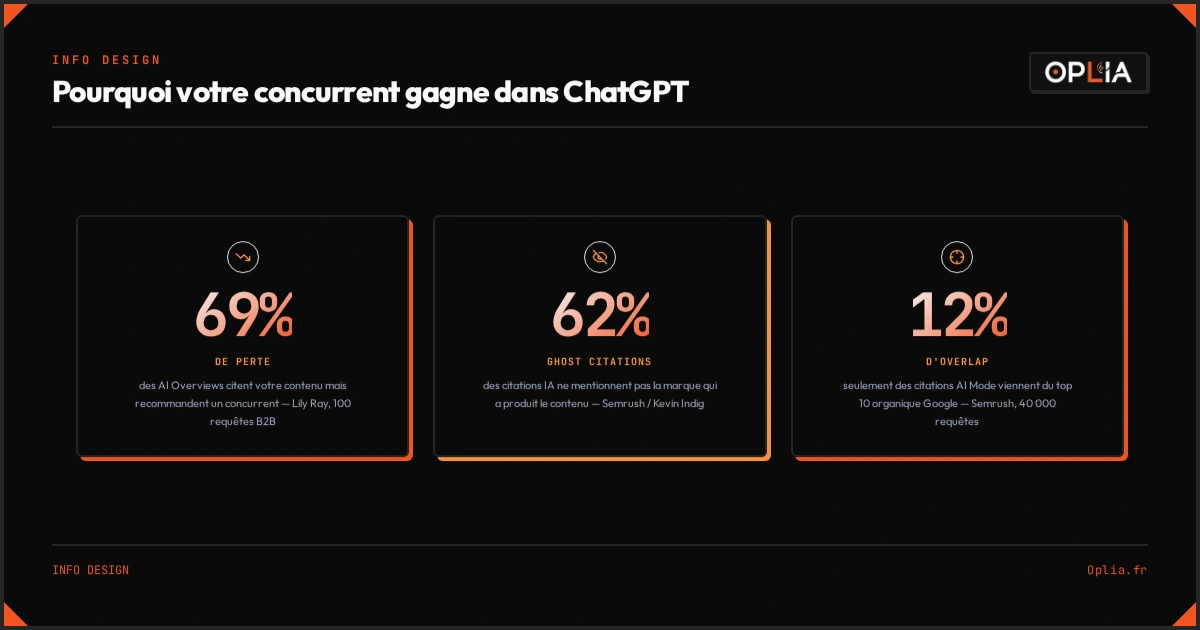
“Only 12% of citations in Google AI Mode match URLs from the organic top 10.” — Semrush, analysis of 40,000 queries (May 2026)
Query fan-out: why your page gets discarded
When a customer types “What’s the best plumber in Avignon?” into ChatGPT, the AI doesn’t search for a single answer. It breaks the question down into 5 to 15 internal sub-questions: “emergency plumber Avignon,” “affordable plumber Avignon,” “plumber reviews Avignon,” “certified plumber Avignon,” “how much does a plumber cost in Avignon.”
For each sub-question, the AI retrieves web pages through traditional ranking systems. Then it compares the title and snippet of each page against its sub-question. If the title doesn’t match, the page is discarded — even if its content is excellent.
The Ahrefs study confirms this: out of 33 URLs retrieved per prompt, only half are cited. The other half are discarded after reading the title and snippet alone.
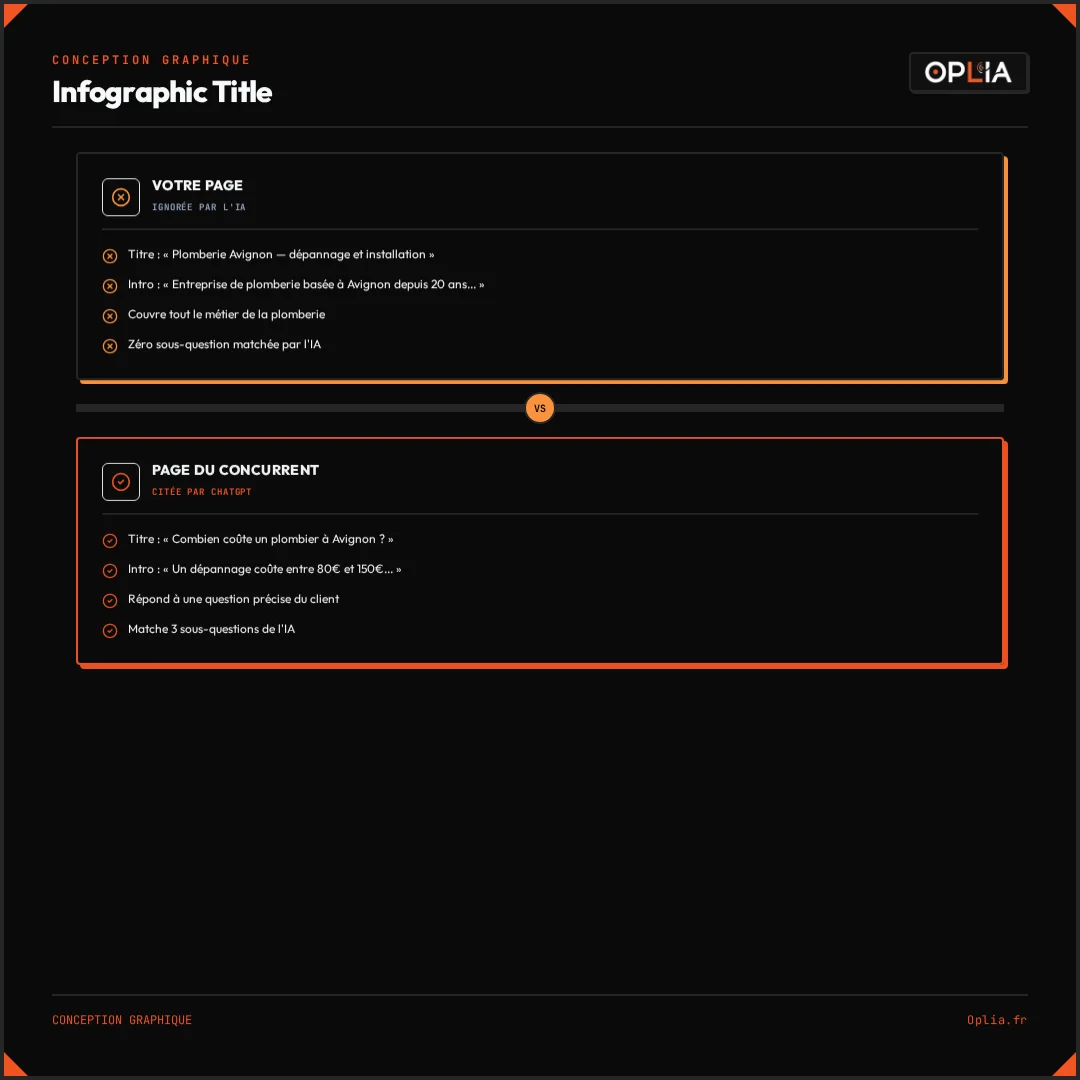
Your homepage that says “Avignon Plumbing — 24/7 service — Free quote” doesn’t answer any of the 15 sub-questions the AI asks itself. Your competitor’s page with an article titled “How much does unclogging a sink cost in Avignon?” perfectly matches a specific sub-question. The AI keeps it.
| Your page ❌ | Competitor’s page ✅ |
|---|---|
| Title: “Avignon Plumbing — repairs and installation” | Title: “How much does a plumber cost in Avignon?” |
| Intro: “Plumbing company based in Avignon for 20 years…” | Intro: “A plumbing repair in Avignon costs between €80 and €150…” |
| Covers the entire plumbing trade | Answers a specific question |
| Zero sub-questions matched | Matches 3 of the AI’s sub-questions |
What I’ve learned in the field: A landscaper client in Toulouse had a perfect site. 85/100 technical score, 3rd position on Google. In ChatGPT, he was invisible. A competitor, lower-ranked, was cited every time. We looked at the competitor’s pages: 5 blog posts with titles like “What’s the budget for a landscaper in Toulouse?”, “When to trim your hedge in Haute-Garonne?”. Each post answered a specific question in the first paragraph. In 4 weeks, by restructuring his content on the same model, my client went from 0 to 3 citations in ChatGPT Search.
How does an AI compare my business to my competitors?
The answer is counterintuitive: the AI doesn’t actively compare businesses against each other. It compares the relevance of each source to a specific question. And that’s where the problem lies.
The problem of ghost citations
The Semrush study conducted with Kevin Indig (June 2026) reveals that 62% of citations made by AIs don’t mention the brand that produced the content. They cite the information without linking to the source. These are “ghost citations.”
In practice: you write an article “How to choose a plumber in Avignon?” that gives useful advice. ChatGPT cites your article in its response but doesn’t mention your company’s name. The prospect reads the information but doesn’t know it was YOU who wrote it. Result: zero customers, zero calls. I explained this phenomenon in detail in my article on how to get your brand to appear in ChatGPT — the ghost citation trap is the most insidious one in GEO.
Meanwhile, your competitor — who has less content but whose name is cited in forums, local press articles, and comparison sites — appears explicitly in the AI’s response. Because LLMs cross-reference information across multiple sources. If your business is mentioned across 20 different sources (forums, local news, directories), the AI considers you a known and trusted entity. If you’re mentioned nowhere, you don’t exist to it.
The trap of self-promotional listicles
This is the most costly trap. Lily Ray (Amsive) analyzed 100 B2B “best [category] software” queries on Google AI Overviews. Result: AI Overviews cite brands’ self-promotional listicles in 323 cases, but recommend their competitors in 69% of cases.
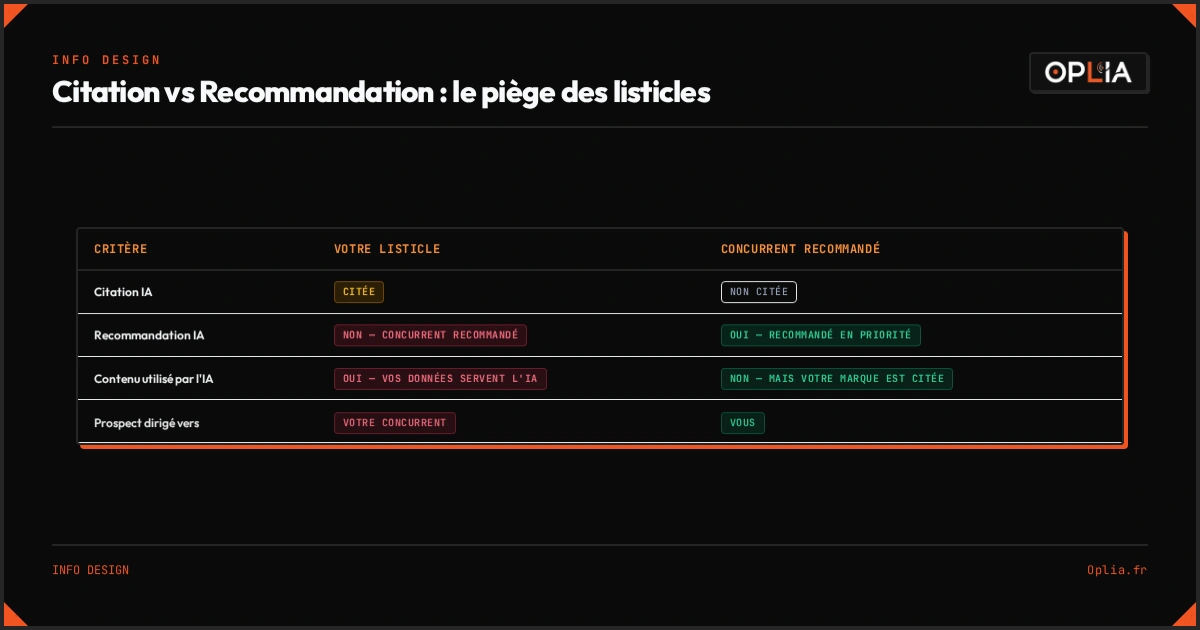
Your page “Why choose our plumbing company?” or “Top 5 plumbers in Avignon” (where you’re #1) is read and cited by the AI. But the final recommendation — the name the AI gives priority to the prospect — goes to your competitor. Because the AI cross-references your content with other sources: Google reviews, forums, press. If your competitor has more third-party mentions than you, the AI recommends them instead of you.
“69% loss rate: AI Overviews cite your listicle but recommend a competitor in more than 2 out of 3 cases. It’s a machine for sending traffic to your competitors.” — Lily Ray (Amsive), analysis of 100 B2B queries, Search Engine Land (June 2026)
What are the 5 levers to tip the scales in my favor?
The good news: the game isn’t rigged. The rules are known and actionable. Here’s what I apply with the small businesses I support to help them surpass their competitors in AI responses.
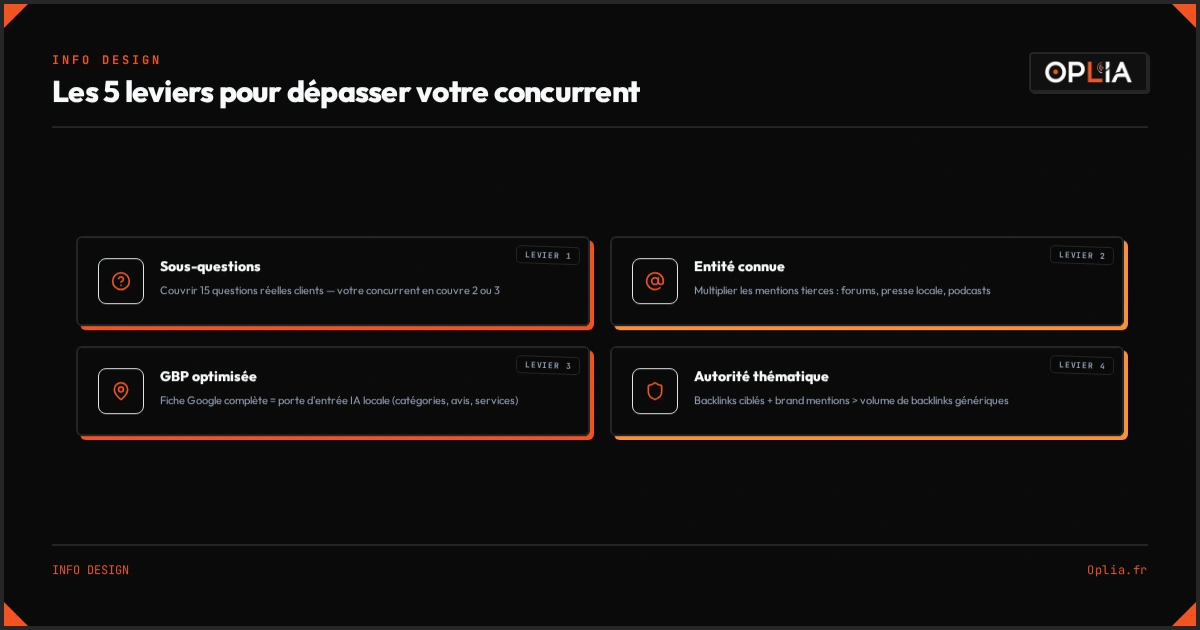
Lever 1: Cover the sub-questions your competitor ignores
The Ahrefs study (1.4 million prompts) confirms that cosine similarity between a page title and the AI’s sub-question is the decisive citation factor: 0.656 for cited pages vs. 0.484 for uncited pages.
The concrete action: List 15 real questions your customers ask you. Create a page or a section for each question, with the exact question as the title and a direct answer in the first paragraph. I detailed this query fan-out mechanism in my article on GEO and how AIs decide to recommend a business. Your competitor probably has 2 or 3 pages like this. If you have 15, you cover 5 times more sub-questions than they do.
Natural-language titles achieve an 89.78% citation rate vs. 81.11% for traditional SEO titles (Ahrefs). Changing “Our plumbing services” to “How much does a leak repair cost in Avignon?” isn’t a stylistic exercise — it’s a statistical lever.
Lever 2: Become a known entity to LLMs
LLMs don’t cite brands they “discover” in a single page. They cite them when they “recognize” them across multiple sources. The WordCamp Europe 2026 panel was unanimous: brand awareness has become an AI ranking signal.
In practice: if your business is mentioned on 5 specialized forums, 2 local press articles, 1 podcast interview, and 3 trusted directories, the AI considers you an established entity. If your competitor is only mentioned on pages they created themselves, the AI will hesitate to recommend them.
“Brand awareness becomes an AI signal: LLMs cite the brands they know.” — WordCamp Europe 2026 Panel (Alex Moss, Pam Aungst Cronin, Jovana Smoljanovic, David Cuesta)
What counts more than backlinks: brand mentions on authoritative forums, citations in local press articles, detailed reviews on verified platforms. BrightEdge showed (June 2026) that AI systems assign different roles to the same sources depending on context. Reddit is treated as an authoritative source by ChatGPT in 36% of cases — as much as a medical source. LinkedIn is seen as social by ChatGPT but professional by Google AIO. A multi-platform mention strategy is essential.
Lever 3: Optimize your Google listing before your website
Google AI Mode cites heavily via Google Maps and Google Business Profiles. The SE Ranking study on 10,000 AI Mode keywords confirms it: Google.com is the most-cited domain in AI Mode responses, mainly via Google Maps.
If your competitor has a complete Google Business Profile (categories, hours, reviews with responses, named photos, listed services) and yours is half-filled, the AI recommends them before you — even if your website is better.
Competitive differentiation points on your GBP:
- Filled-in secondary categories (your competitor may have forgotten theirs)
- Responses to ALL reviews (not just positive ones) — the AI scans exchanges
- Photos with descriptive filenames (not
IMG_20240301.jpg) - Services listed with indicative pricing
Lever 4: Build topical authority, not volume
Backlinks remain important — the Semrush study on 1,000 domains confirms they help SEO AND become an authority signal for AI responses. But quality trumps quantity.
LLMs cross-reference information across multiple sources. A backlink from a FrenchWeb or Blog du Modérateur article that mentions your company name AND your specialty is worth 50 backlinks from link farms. It’s exactly the same principle I explain in my article on why a website brings in no customers — but applied to AI.
Concrete application against your competitor: Identify the 3 authority sites in your sector (local press, professional federation, trusted comparison site). Seek to be mentioned there — not just as a backlink, but as a brand citation. Your competitor may be doing volume backlinks. A single well-placed citation can surpass them in the AI’s eyes.
Lever 5: Analyze the weak signals of your position against the competitor
GEO isn’t just about counting citations. Qualitative signals matter more than volume. Here’s how to tell whether you’re gaining or losing ground against a competitor:
| Signal | What it means | Action |
|---|---|---|
| The AI cites you AFTER your competitor | You’re an alternative, not the reference | Strengthen your topical authority |
| The AI says “[Your name] is an interesting option” | Reservation — perceived authority deficit | Multiply third-party mentions |
| The AI uses “may be relevant if,” “more oriented toward” | The AI isn’t sure about recommending you | Structure your pages to match sub-questions |
| Your brand ONLY appears if its name is in the question | Conditional visibility, not organic | Work on sub-question coverage outside your brand |
| The AI cites your content without naming your brand | Ghost citation — you’re giving away free content | Add your brand name in H1/H2 and first paragraph |
What I’ve learned in the field: An electrician client in Lyon was cited by ChatGPT — but always in second position, after the same competitor. The signal was clear: “an interesting option” every time. We worked on two levers: direct answer in the very first paragraph and obtaining 3 mentions on recognized DIY forums. In 6 weeks, he went from second to first citation for “electrician Lyon,” and the “interesting option” disappeared.
Why can creating “best of” pages help my competitors?
If you have a page like “Why our company is the best” or “Top 5 plumbers in Avignon,” you’re taking a risk that few businesses measure.
Google AI Overviews uses your content to answer the user’s query. But the final recommendation — the priority name — is determined by cross-referencing sources. If your competitor has more third-party mentions than you, the AI recommends them while citing your content as the source.
It’s a double penalty: you produce the content, your competitor reaps the customer.
What to do instead
Don’t delete your comparison pages — transform them:
- Add objective comparison criteria where your business stands out (warranty, certifications, response times, coverage areas)
- Structure the page to answer specific sub-questions your competitor doesn’t cover
- Obtain verified testimonials and reviews that anchor your legitimacy
- Add verifiable data points (number of jobs per year, customer satisfaction, average prices by service type)
LLMs value specific, verifiable data. An article titled “Why our company” with no numbers or third-party proof will be used by the AI to recommend your competitor. An article that says “97% satisfaction across 340 verified reviews — guaranteed response within 2 hours” gives the AI a reason to recommend you.
Where to start concretely to overtake my competitor in ChatGPT?
Here are the actions I recommend to the small businesses I support. The order matters — do them in sequence.
- Audit your competitor’s position: type the question your ideal customer would ask into ChatGPT Search. Note the first 3 brands cited in order. The first cited = the AI reference.
- Analyze why your competitor wins: look at their website. Do they have pages with question-format titles? A structured FAQ? Mentions on forums or local press? Identify 2 things they do better than you.
- Create 3 pages answering sub-questions they ignore: list 15 customer questions. If your competitor covers 3, create 5 new ones they don’t have. Each page = question as title + direct answer in the first paragraph.
- Optimize your Google Business Profile: categories, reviews with responses, services with pricing, named photos. Your competitor may have neglected one of these points.
- Get 3 third-party mentions: local press, specialized forum, professional association. One external mention is worth 10 pages of self-promotional content in the eyes of LLMs.
- Test your progress: ask the same question in ChatGPT 4 weeks later. Is your business higher than before? Have the hedging phrases (“interesting option”) disappeared?
- Repeat on Perplexity and Google AI Mode: each AI platform has its biases. BrightEdge confirmed it — the same sources aren’t treated the same way depending on the engine.
Summary — checklist:
| # | Action | Done? |
|---|---|---|
| 1 | Audited competitive position in ChatGPT — notes taken | ☐ |
| 2 | Identified my competitor’s 3 strengths | ☐ |
| 3 | Created 3 pages answering ignored sub-questions | ☐ |
| 4 | Google Business Profile 100% complete | ☐ |
| 5 | Obtained 3 third-party mentions (forums, press, directories) | ☐ |
| 6 | Tested my progress after 4 weeks | ☐ |
| 7 | Verified my position on Perplexity and Google AI Mode | ☐ |
Interpret your score:
- 0-2: You’re in the observation phase. Priority: audit your competitor and complete your Google listing. Without these foundations, the rest is ineffective.
- 3-5: You’re building your competitive advantage. First citations should arrive within 2 to 4 weeks. Keep structuring your content.
- 6-7: You have a head start. Monitor weak signals and keep the pressure on — your competitors probably aren’t yet aware of this mechanism.
Key takeaways
- Your Google ranking doesn’t protect you from competitor recommendations — 88% of AI citations come from pages outside the organic top 10. Being #1 on Google doesn’t shield you.
- Self-promotional listicles help your competitors — 69% loss rate confirmed by Lily Ray. A citation is not a recommendation. Don’t produce content that serves your competitors.
- Brand awareness is your best competitive shield — LLMs cite the brands they “know” across multiple sources. Build third-party mentions, not just content volume.
- Weak signals say everything — if the AI calls you “an interesting option,” you’re losing to your competitor. If it talks about you without hedging language, you’re winning. Monitor these signals, not just citation counts.
- Consistency beats power — 3 to 6 weeks to start seeing results. No magic boost. Every sub-question covered is a small cumulative advantage.
The game is still wide open. Few businesses understand this mechanism. Those who integrate it now will build a lead that their competitors will take months to identify, and even longer to catch up.
If you want to check where you stand against your competitors, I offer a free audit of your AI and Google visibility. We’ll look together at who’s cited first, why, and the 3 actions that will have the most impact to turn the tide. No commitment — we show before we sell.
Further reading
- How to get my brand to appear in ChatGPT? — The 5 fundamental actions to appear in AI responses
- What is GEO and how do AIs decide to recommend my business? — The complete guide to query fan-out and AI citation mechanisms
- My site doesn’t appear on Google: where to start? — SEO fundamentals before tackling GEO
In a world where AI chooses who to recommend, the best defense against your competitors is not to attack them — it’s to become the answer the AI cannot ignore.
Need local support? Discover our service areas across France.