Outsourcing My Website's SEO to a Provider Without Getting Ripped Off?

The bottom line: Most unscrupulous SEO providers just generate automated reports and buy toxic links. Spotting the warning signals, auditing the monthly deliverables, and imposing a trial period let you select a reliable, transparent partner.
What you will learn:
- Identify the 7 red flags that betray an opaque provider
- Ask the 6 decisive questions before committing contractually
- Structure a 3-month pilot project to test real skills
- Use a scored evaluation grid to audit your current provider
Before you continue: This article is aimed at SMB owners who already have a website and want to outsource their SEO. If you don’t have a site yet, or your budget is under €300 per month, start with our guide on the local SEO pillar.
A figure keeps coming up in the industry: in several generalist SEO agencies, a single consultant manages up to 30 client accounts simultaneously. Based on 160 working hours per month, the time actually allocated to each account rarely exceeds 30 minutes per month. Just enough to pull a screenshot from Google Search Console, paste it into an automated report template, and send it off.
Yet these services are routinely billed at €1,500 to €3,000 per month to business owners who know nothing about the technical backstage.
The problem: You hand over your company’s visibility to a third party without the metrics to verify whether the work is actually done. Unscrupulous providers profit from this technical opacity.
The solution: This guide gives you a 7-point audit method to objectively evaluate an SEO provider. Ten minutes of reading is enough to spot the warning signals and set the essential requirements before you commit.
Table of Contents
- Why Outsource Your SEO to a Provider Instead of Doing It Yourself?
- Which Red Flags Don’t Lie?
- How Do I Know If My SEO Provider Is Actually Doing a Good Job?
- How Much Should Quality SEO Cost?
- How to Test a Provider Without Committing for a Year?
- How to Audit Your SEO Provider Today?
- Key Takeaways
- Further Reading
Why Outsource Your SEO to a Provider Instead of Doing It Yourself?
Organic SEO requires method and consistency. Between the technical audit, semantic analysis, optimized content production, link acquisition, and metric analysis, a rigorous SEO strategy demands 15 to 20 hours of work per month for an SMB.
For a business owner, this time directly competes with day-to-day operations, team management, and client relationships.
Outsourcing this mission to an expert is a rational choice, provided you work with a professional who is transparent about his deliverables and method.
According to the Semrush guide on choosing an SEO company, the essential services include: an initial technical audit, targeted keyword research, on-page optimization, quality link building, and regular activity reporting. If a provider omits several of these pillars, the service delivered remains incomplete.
What I learned in the field: The director of a recruitment firm in Bordeaux contacted me after a four-year contract at €490 per month with a web agency. The agency billed “continuous SEO support”. Looking at the history, no page had been optimized since the initial build, and the only links created came from obsolete automated directories. Worse: the contract stipulated that the domain name belonged to the agency. It took six weeks of administrative procedures to recover her access and transfer her site.
Which Red Flags Don’t Lie?
Here are the 7 signals we compiled by cross-referencing business owners’ feedback, technical community analyses, and our own field experience. If your provider ticks 3 of these criteria, a serious conversation is in order.
1. They Sell You Guaranteed Results
No provider, Google included, can guarantee a specific position in search results. Algorithms evolve continuously. A provider that promises you the #1 spot within a fixed deadline is either using deceptive methods or penalizable practices that will put your domain at risk at the next Google update.
“No one can guarantee the #1 position on Google. Beware of SEO providers that claim to guarantee rankings, say they have a privileged relationship with Google, or tout priority submission.” — Google Search Central, Official documentation for webmasters (Google, 2026)
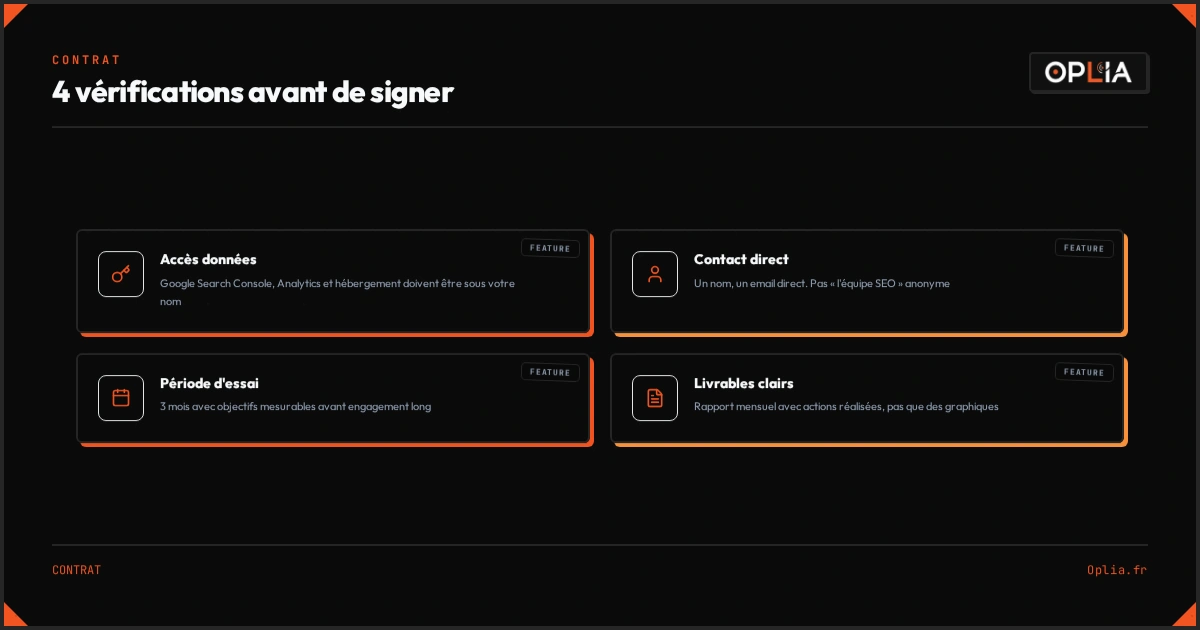
2. They Don’t Give You Access to Your Own Data
Your Google Search Console account, your audience analytics tool, and your hosting access are assets of your company. A provider that refuses to grant you administrator rights puts you in a dependency situation: you cannot switch partners without risking the loss of your site’s history.
3. They Send You Reports Without Concrete Actions
A report showing traffic charts without detailing the technical or editorial work done during the month does not justify your fees. The opaque agency playbook often boils down to: log into Search Console, take a screenshot, paste it into a PDF template, and send it to the client.
“In many generalist agencies, the SEO workflow boils down to opening Search Console, taking a screenshot, and inserting it into a template. Zero optimization on the site, zero quality content creation. Clients are funding an automated report rather than real work.” — r/TechSEO community discussion (Reddit, 2026)
4. They Mass-Produce Low-Cost Content
Setting artificial volumes without quality control directly hurts your reputation and your rankings. One client shared his experience after paying €5,000 for a 6-month contract: he received 40 automatically written articles with no human review, 200 toxic links created on blog farms (PBNs), and a generic technical audit that never fixed a page load time above 8 seconds.
5. Their Price Is Abnormally Low or Completely Opaque
A €99-per-month offer cannot fund qualified working time. At the other end, a €5,000 monthly invoice without a precise breakdown of deliverables is unjustified spending. A serious agency provides a clear breakdown of its rates and ties each amount to measurable deliverables.
6. They Refuse to Provide Client References
An experienced professional gladly presents concrete case studies, verifiable testimonials, and examples of traffic growth. A systematic refusal to share references or contacts of current clients usually signals a lack of proven track record.
7. They Impose a Long Contract Without a Trial Period
A firm 12- or 24-month commitment without a probationary period locks up your cash flow without guaranteeing performance. As the Semrush guide to choosing an agency points out, starting with a one-off assignment, such as an in-depth audit, or a 3-month trial period lets you test the provider’s reliability before considering a long-term collaboration.

How Do I Know If My SEO Provider Is Actually Doing a Good Job?
Ask these 6 precise questions to your contact. Their written answers allow you to immediately assess their level of professionalism.
| Question to ask | Expected answer | Red flag |
|---|---|---|
| ”Can you show me an example of a monthly report?” | A detailed document with annotated data, the month’s actions, and a plan for the following month | ”We send you a summary by email” with no structured deliverable |
| ”What tools do you use to track my rankings?” | Google Search Console, Semrush, Ahrefs, or a named analytics tool | ”We have our own internal tools” with no demonstration |
| ”Who will be my direct point of contact day to day?” | A first name, a last name, and a direct email address | ”The technical team” or an unidentified generic account |
| ”How do you adapt your work to Google updates?” | A clear explanation of their monitoring and readjustment protocols | ”We follow this closely” with no explicit method |
| ”How many client accounts does each consultant manage?” | A controlled ratio, typically 5 to 15 clients per expert | A consultant assigned more than 25 simultaneous accounts |
| ”Is it possible to talk to one of your current clients?” | A direct introduction to a consenting client | ”All our contracts are strictly confidential” |
Tip: Send these questions by email before signing. Written answers constitute a moral contractual commitment and let you objectively compare several quotes.
How Much Should Quality SEO Cost?
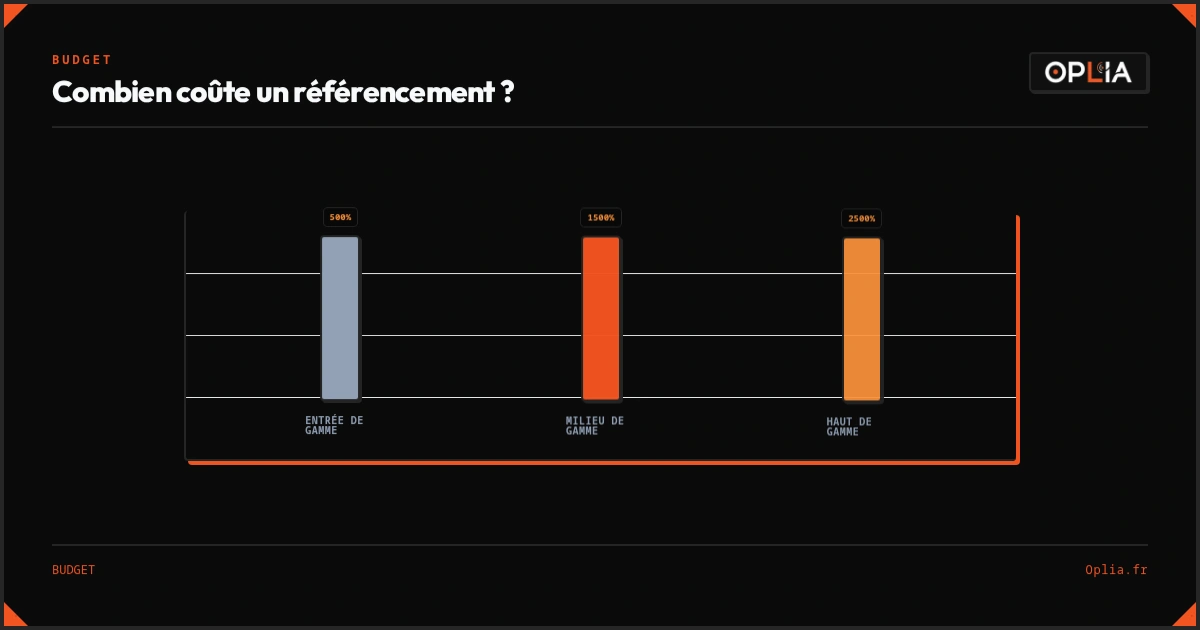
French market rates for SMBs in 2026 revolve around three main budget categories. The benchmark Ahrefs study on SEO pricing confirms that structured monthly packages are the dominant model in the industry.
| Service level | Estimated monthly budget | Included deliverables |
|---|---|---|
| Entry-level | €300 to €500 | Search Console monitoring + Google Business Profile optimization + monthly report + 1 to 2 technical adjustments |
| Mid-range | €500 to €1,500 | Full technical audit + semantic strategy + expert content writing + targeted link building + monthly monitoring |
| High-end | €1,500 to €2,500 | Global SEO strategy + GEO optimization (ChatGPT, Perplexity) + authority link building + in-depth analytics reporting |
Below €300 per month, the allocated working time does not allow for sustainable technical or editorial actions. The provider can only devote one to two hours per month to it.
Above €3,000 per month without detailed justification, demand a precise assessment. Several documented reports on the r/SEO community mention excessive billing for monitoring limited to a few dozen keywords with no real work behind it.
How to Test a Provider Without Committing for a Year?
To limit financial risk, we recommend a progressive three-step approach before any multi-year commitment.
Step 1: Ask for an Initial Audit
A qualified professional can analyze your site and provide a technical diagnosis within a few days. Run away from automated 50-page reports generated without human analysis. Favor a targeted analysis that identifies your real bottlenecks. If the audit is paid, the expense remains healthy as long as the deliverable is actionable, even without a contract following.
Step 2: Set Up a 3-Month Pilot Project
Engage the provider for one quarter with precise, measurable goals, for example:
- Fix the indexing anomalies reported in Google Search Console
- Optimize loading speed to reach a mobile score above 80 on Google PageSpeed
- Produce and publish 3 high-value thematic guides
- Structure the internal linking on your strategic service pages
If the provider refuses this probationary phase and demands a direct 12-month commitment, look for another agency.
Step 3: Check the Deliverables Every Month
A rigorous provider hands you a structured report each month, including:
- Newly indexed pages and the evolution of target rankings
- Real organic traffic evolution (users, sessions, conversions)
- The precise details of the optimizations carried out during the past month
- The detailed roadmap for the month ahead
- Maintaining your administrator access to Google Search Console
If you only receive screenshots without contextual explanation, the provider automates its reports without working on your site.
How to Audit Your SEO Provider Today?
- Identify your 5 priority keywords and note your current position on Google
- Check that you have administrator rights on your Google Search Console account
- Ask your current provider for the detailed summary of the actions carried out over the last 3 months
- Test your homepage loading speed on Google PageSpeed Insights
- Count the number of pages indexed on Google using the
site:yourwebsite.comcommand - Send the 6 qualification questions presented in this article in writing
- Examine your domain’s link profile with a free tool like Ahrefs Webmaster Tools
Evaluation grid for your current provider:
| # | Evaluation criterion | Validated? |
|---|---|---|
| 1 | You have direct administrator access to your Google Search Console | ☐ |
| 2 | Your provider assigned you an identifiable technical point of contact | ☐ |
| 3 | The latest monthly report details concrete actions, not just curves | ☐ |
| 4 | You validated at least one tangible deliverable in the last 30 days | ☐ |
| 5 | Your provider gave you verifiable client references | ☐ |
| 6 | Your contract includes a termination option with 30 days’ notice | ☐ |
| 7 | The provider makes no promise of results or guaranteed ranking | ☐ |
Interpreting the results:
- Score of 0 to 2: Your provider is not delivering the expected work. We recommend terminating your contract and changing partners.
- Score of 3 to 5: Some opacity remains. Schedule a review meeting to demand precise deliverables and full access to your data.
- Score of 6 to 7: Your collaboration rests on healthy foundations. Keep monitoring the key indicators every month.
Key Takeaways
- Transparency is the first selection criterion. Your data must belong to you, your point of contact must be identified, and every action must be documented.
- Guaranteed ranking promises are deceptive. No provider controls Google’s algorithms. Run away from unrealistic commitments and rock-bottom offers.
- Favor a 3-month trial phase. A pilot project with measurable indicators protects you before any multi-year commitment.
If you want an objective opinion on the actions carried out by your current agency, or if you are looking for transparent support focused on concrete deliverables, discover how we can help you.
Further Reading
- Google Business Profile in 2026: What Really Matters: optimize your local profile to strengthen your visibility and feed AI search engines.
- Which Clauses in My Agency Contract Should Raise Red Flags?: spot the contractual traps before signing a commercial agreement.
- I Tested ChatGPT for My Business, Why Isn’t It Working?: understand the customization requirements for creating useful, high-performing content.
A competent SEO provider doesn’t sell you theoretical rankings. It brings you the method and the rigorous work essential to sustainably grow your visibility.
Need local support? Discover our service areas across France.