Do You Really Need 2,000-Word Articles to Rank on Google?

The bottom line: No. Google doesn’t require any word count, and the studies pushing you to target 2,000 words confuse correlation with causation. The right length is the one that fully covers the topic — without a single filler word more.
What you’ll learn:
- Where the 2,000-word figure comes from and why it’s wrong
- What the studies and Google actually say about length
- The length that works to get cited by AIs
- A simple method to decide the length of every article
Before you continue: This article is for SMB owners who produce (or have produced) content for their website. If you first want to understand which pages create real customers, start with our guide on keywords that bring real customers.
One day, an accountant client asked me the question that comes up over and over: « I need 2,000 words per article, right? That’s what I was told to rank first on Google. »
He had just read an article claiming exactly that. One more.
The problem: You’ve been told for years that an article must be 2,000 words to rank. That figure has become a reflex, a production target, almost a superstition.
The solution: This article dismantles the myth with real data and gives you a method to decide the right length for each piece of content. Eight minutes of reading.
Table of Contents
- Where does this 2,000-word figure actually come from?
- Why do studies seem to say long articles rank better?
- What does Google really say about article length?
- How many words do you need to get cited by ChatGPT and AIs?
- So what length should you actually aim for?
- Key takeaways
- Going further
Where does this 2,000-word figure actually come from?
When we support business owners with their SEO visibility strategy, this 2,000-word question comes up systematically. In reality, the figure comes from a misreading of correlation studies.
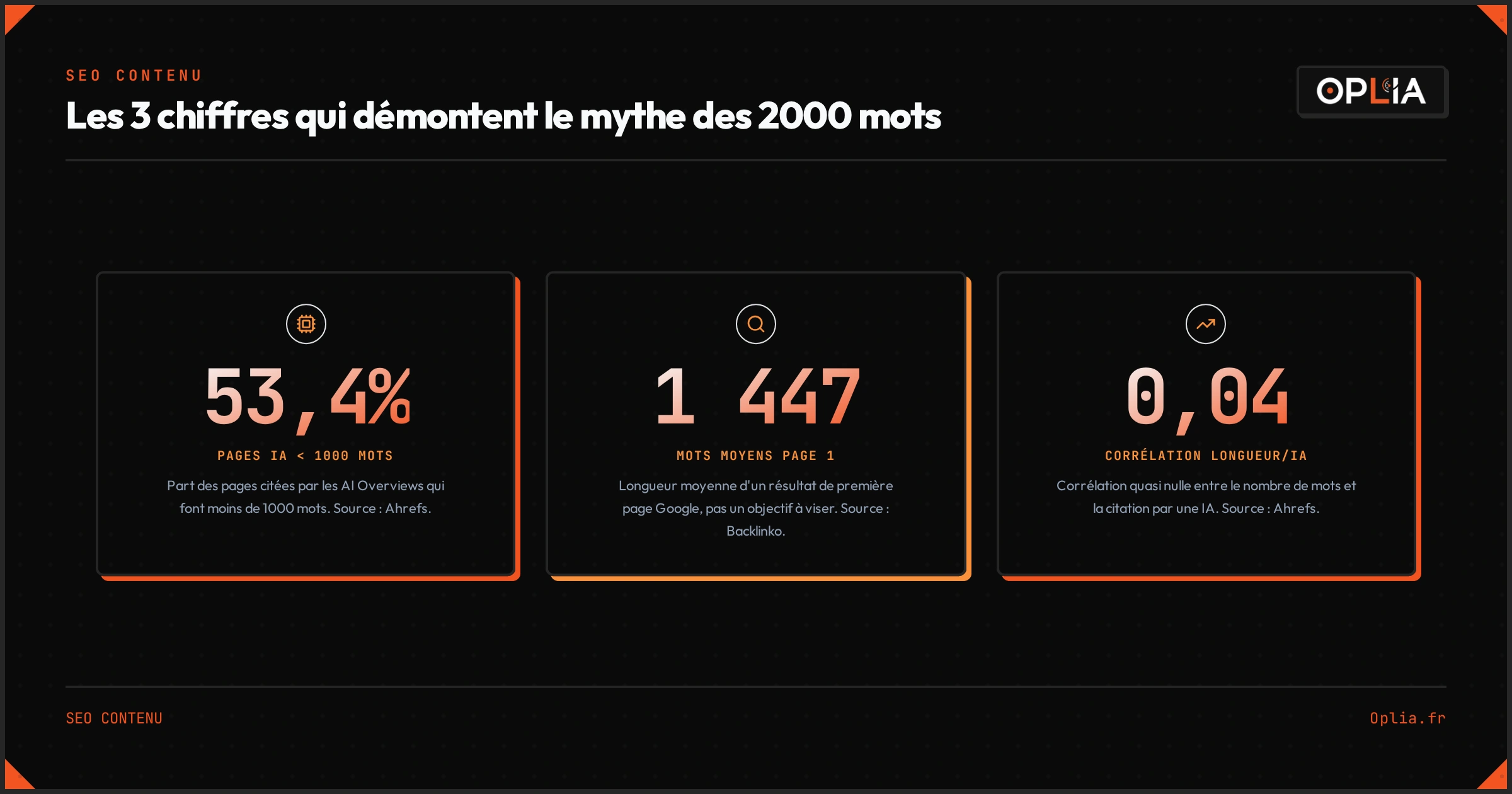
The most famous one is Backlinko’s, run on 11.8 million Google results. It concluded that the average first-page result contains 1,447 words (Backlinko study on ranking). Someone rounded, inflated, and the figure became « 2,000 words » in hundreds of tutorials.
But an average says nothing about what you should do. An average mixes 300-word pages and 7,000-word guides. Nor does it say whether length is the cause of rankings, or just a coincidence.
« Word count is not a ranking factor. » — John Mueller, Search Advocate at Google, quoted in the Ahrefs analysis on article length
That has been Google’s official position since 2019. And it hasn’t changed.
Why do studies seem to say long articles rank better?
Because they measure correlation, not causation. That’s the central trap.
Ahrefs analyzed nearly 900 million pages and found a positive correlation between length and backlinks, then between length and traffic. But looking closer, the curve tells another story (Ahrefs analysis on article length):
| Article length | What’s actually happening |
|---|---|
| Up to 1,000 words | The longer, the more links it gets |
| Beyond 1,000 words | The correlation with links reverses |
| Up to 2,000 words | The longer, the more traffic it gets |
| Beyond 2,000 words | The correlation with traffic reverses |
In plain terms: a 10,000-word article gets on average less traffic than a 2,000-word article.
What this means for you: long articles don’t rank better because they’re long. They rank better because they cover the topic thoroughly, which attracts links and traffic. Length is a consequence, never a lever.
What does Google really say about article length?
Google is clear, and it’s even written in black and white in its official documentation.
In its « creating helpful content » guide, Google lists the signals that betray content produced for search engines rather than humans. Among them, in so many words: « Writing to a specific word count (there isn’t one) » (Google documentation on helpful content).
The Helpful Content Update, which has penalized useless content since 2022, never mentioned a preferred length. What Google rewards is a complete answer and value delivered to the reader.
That’s reassuring. But it means giving up a comfortable reflex: the word counter as a compass. There’s no shortcut; you have to think in terms of topic coverage.
How many words do you need to get cited by ChatGPT and AIs?
Even fewer than for Google. And that’s good news for SMBs.
The Ahrefs study on AI Overviews citations is unambiguous: 53.4% of cited pages are under 1,000 words, and the correlation between word count and citation position is 0.04 — practically zero (Ahrefs study on AI citations).
In other words, AIs don’t favor long articles. They favor direct, clear, well-structured answers.
What this means for you: if you want ChatGPT or Perplexity to recommend your business, a 400-word answer that gets straight to the point beats a 3,000-word block drowning in filler. Structure and clarity beat volume. To go further on AI visibility, read our guide on how to be the first source cited by Perplexity and Google AI.
So what length should you actually aim for?
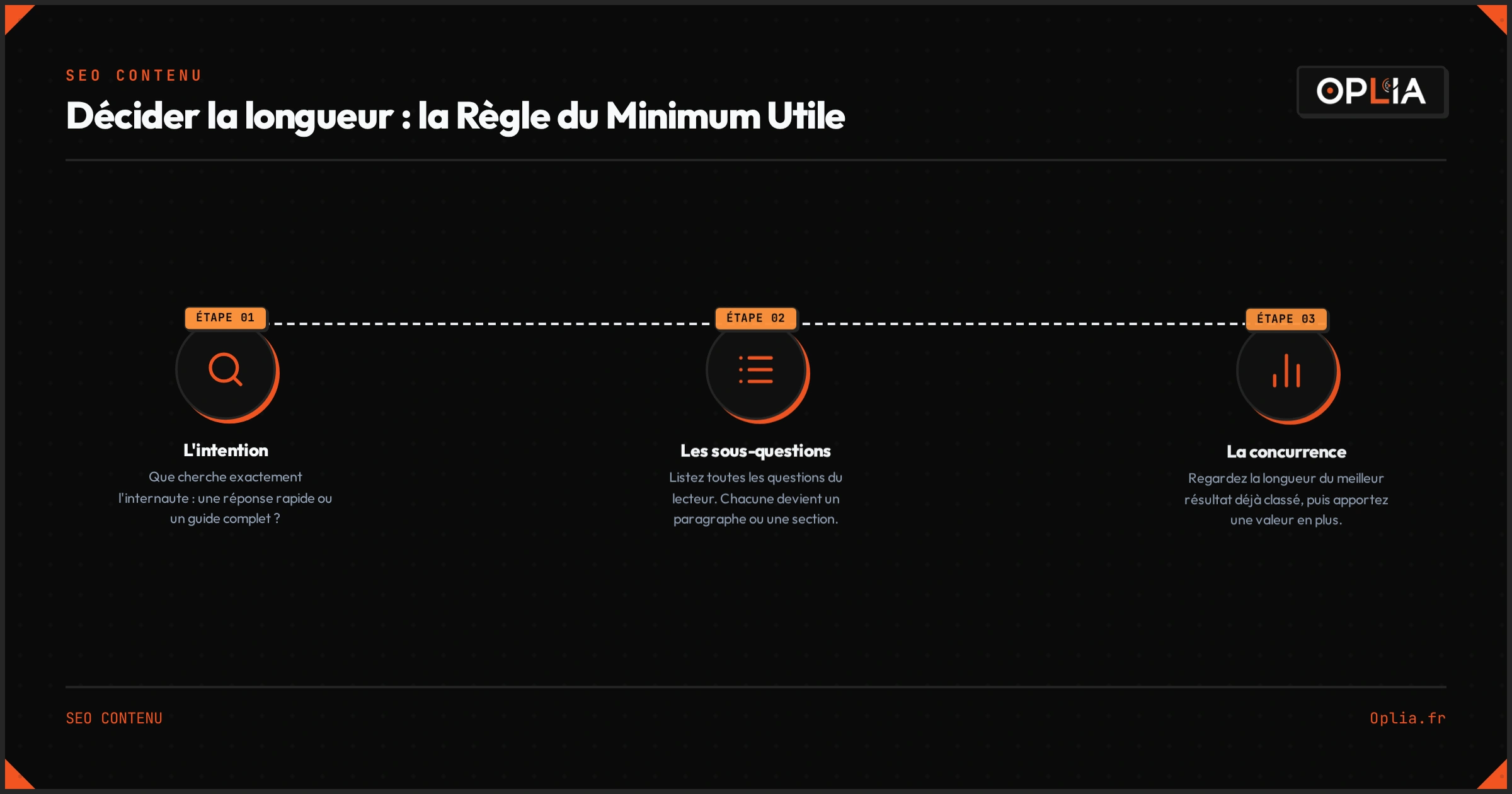
Here’s the method I use, and that you can apply starting today. I call it the Minimum Useful Rule.
An article should be exactly as many words as needed to beat the most complete page already ranking on the topic. Not one word more.
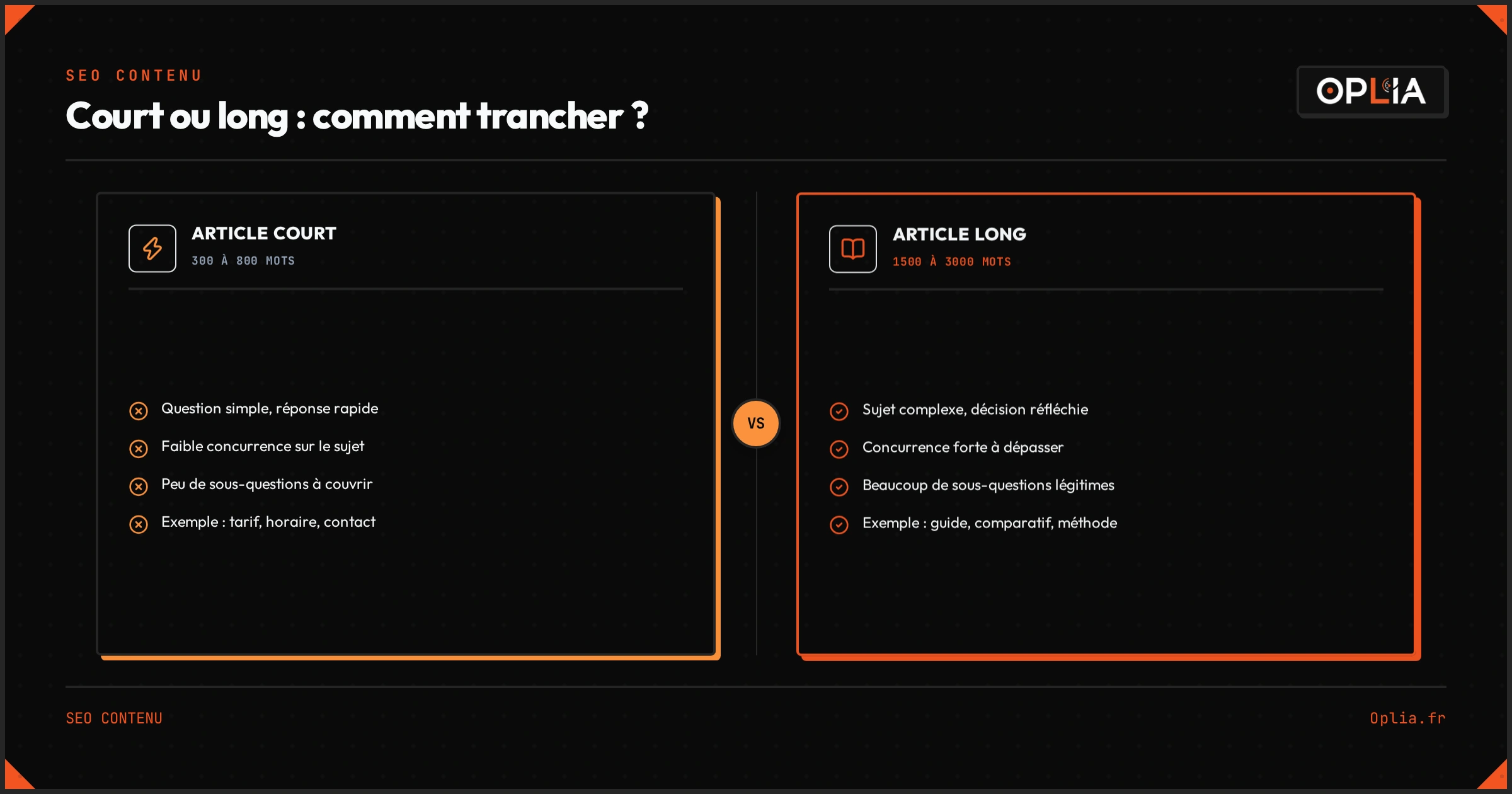
Two lengths coexist depending on the topic. Here’s how to decide:
The rule breaks down into three concrete steps:
Here’s a concrete example. For a simple topic like « how to choose your decennial liability insurance », 500 to 700 words are enough if you answer the question. For a complex topic like « how to choose your SEO provider », 2,000 words are justified because there are dozens of sub-questions to cover.
What I learned in the field: I once cut a client’s article from 1,800 to 700 words by removing the filler the previous agency had added to « build volume ». The article went from page 3 to page 1 within a few weeks. It wasn’t a miracle: the remaining 700 words finally answered the question, without muddying the message with platitudes.
Length isn’t decided upfront, with a word target. It’s observed downstream, once the topic is covered.
Key takeaways
- The 2,000-word figure is wrong: it comes from a misinterpreted average, not a Google requirement.
- Length is not a ranking lever: it’s topic coverage that attracts links and traffic.
- AIs prefer concise: more than half of cited pages are under 1,000 words.
- Decide length afterwards: by intent, sub-questions and competition — never by a counter.
What you need to do:
- Take your next article and list every sub-question of the topic
- Look at the length of the best result already ranking on that topic
- Remove from your drafts any sentence that doesn’t answer any of these questions
| # | Action | Done? |
|---|---|---|
| 1 | I listed the sub-questions of my next article | ☐ |
| 2 | I looked at the length of the best-ranking page on the topic | ☐ |
| 3 | I removed the filler from my latest draft | ☐ |
| 4 | I set the length after covering the topic, never before | ☐ |
| 5 | I checked that each section answers a real reader question | ☐ |
How to read your score:
- 0-2: You’re still writing with a word counter. Re-read the first two sections.
- 3-4: You’ve understood the principle; now apply it systematically.
- 5: You decide length by topic coverage. That’s exactly the right approach.
Going further
- What really works in SEO in 2026? — the overview of the levers that matter
- How to find keywords that bring real customers? — start from intent rather than volume
- I keep hearing about E-E-A-T: what is it and does it concern me? — why expertise beats length
The word counter is a thermometer, never a recipe. Length is earned, not decreed.
Need local support? Discover our service areas across France.