Google Discover and GEO: why your SEO is no longer played in the search bar
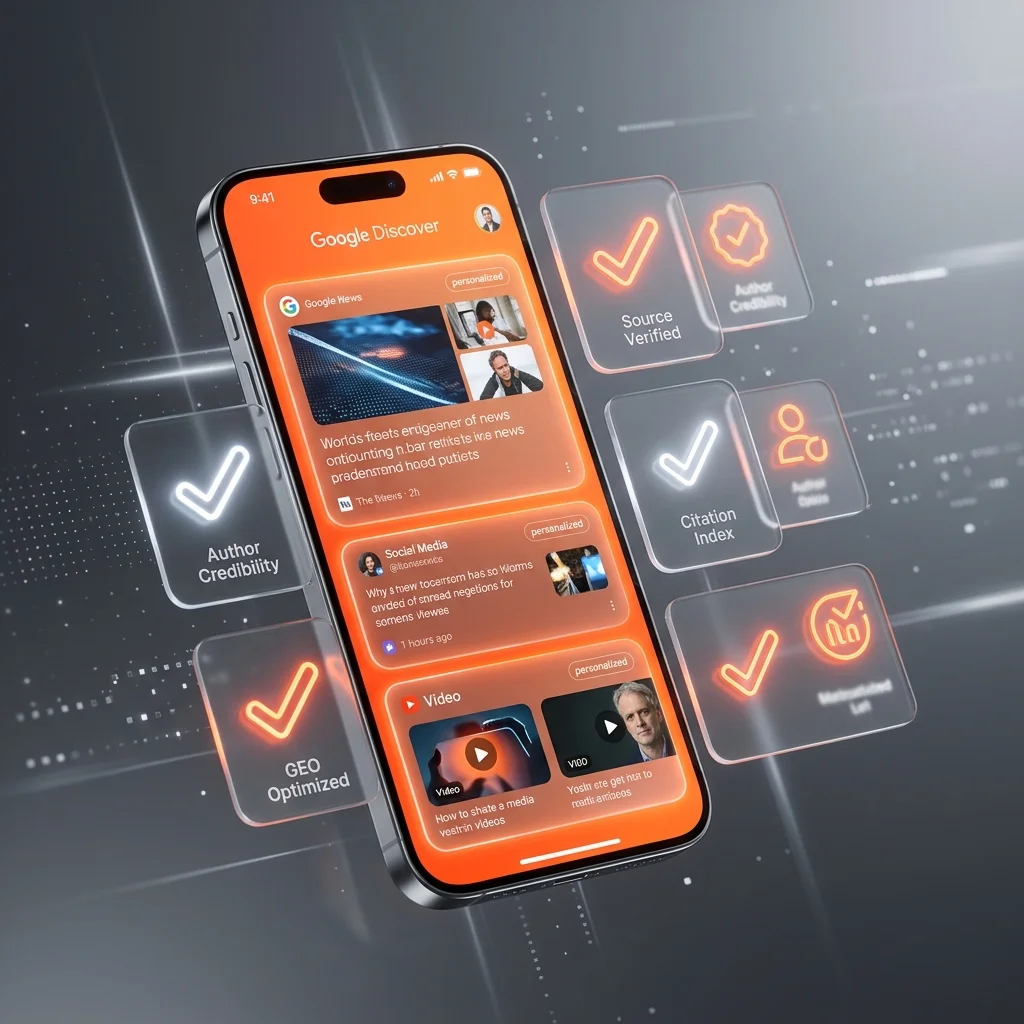
For years, the reflex was simple: rank in first position for a query, capture the click. Two dynamics shatter this model — one deletes the query, the other deletes the click.
A single figure summarizes the shift underway. According to Similarweb, the share of zero-click Google searches went from 56% to 69% between May 2024 and May 2025 — thirteen points in twelve months. In other words: nearly seven out of ten searches now end without a single link being opened. SparkToro had already measured in 2024 that out of 1,000 Google searches in the United States, only 360 resulted in a visit to the open web. Search volume itself continues to grow. This is therefore not a demand crisis, but a distribution crisis: users search just as much, but click much less.
For an agency as for an advertiser, the consequence is concrete: aiming for position 1 is no longer enough to guarantee traffic. Visibility is gradually decoupling from the query and the click. This is exactly the playing field of Google Discover and GEO. Let’s see how these two logics differ from classic SEO, and why they do not replace it either.
Classic SEO, or the mechanics of the query
Traditional organic search optimization rests on a well-oiled chain: a user types a query, Google displays a list of results, your page occupies a position, and this position determines a click-through rate. The whole art of SEO consists in climbing in this list — the famous ten blue links — to capture the maximum number of clics. It is a pull logic: the user expresses a need, you answer it better than others.
This model remains the foundation of any visibility strategy, and it is not about to disappear. But the “query ➔ position ➔ click” chain is cracking at both ends. On one side, Google pushes content to users who are not searching for anything in particular. On the other, generative engines answer directly, without referring to a page. Two fractures, two disciplines.
Google Discover: being seen without anyone searching
Launched in 2018, Google Discover is a feed of personalized content. It displays in the Google app, on the Android home screen, and in mobile Chrome — and, since 2025, Google started deploying it on desktop in certain markets (in France, usage remains mostly mobile in 2026). Its particularity: it does not rely on any query. The user is not searching, they are scrolling. It is Google that decides which article to offer them, based on their interests, browsing history, YouTube videos, or location. We switch from pull to push.
The selection relies on interest profiles rather than keywords: analysis of named entities (people, places, brands, events), thematic alignment with what Google knows about the user, and engagement signals (click-through rate, time spent). On the publisher side, a few levers stand out clearly: a high-quality image (at least 1,200 pixels wide, with max-image-preview:large), content freshness, thematic authority built by regularity, and of course E-E-A-T signals (experience, expertise, authority, trust).
The flip side of the coin: this traffic is unstable by nature. Google says so itself in its documentation — visits coming from Discover are less predictable than those from keyword search, and must be treated as a complement. An article can generate several thousand visits in a few hours, then drop just as quickly: the bulk of the traffic is often played out over 24 to 72 hours. The discipline also depends heavily on the niche: media, lifestyle, and entertainment benefit greatly, while B2B or local service sites rarely appear there. For some press publishers, Discover represents 70 to 80% of their Google traffic — hence the risky temptation to depend on it.
This channel is evolving fast: the Discover Core Update announced by Google on February 5, 2026 (first for English-speaking users in the US, with gradual extension) aims to reduce clickbait and strengthen local, original, and expert content. Good news: a dedicated report in the Search Console allows tracking impressions, clics, and CTR on Discover, separately from classic search.
GEO: being cited without anyone clicking
GEO (Generative Engine Optimization) is the discipline that optimizes the visibility of content within AI-generated responses: ChatGPT, Perplexity, Gemini, Google’s AI Overviews, or Claude. Where SEO looks to rank in a list of links, GEO looks to be selected, synthesized, and cited as a source in a response drafted by a language model. The query still exists — but the click itself often disappears.
The term is not an agency buzzword. It was formalized in November 2023 in a research paper signed by Pranjal Aggarwal et al. (Princeton, Georgia Tech, Allen Institute for AI, IIT Delhi), published on arXiv and then presented at the ACM SIGKDD 2024 conference. Researchers tested nine optimization methods on about 10,000 real queries. The most striking result: the addition of verifiable statistics, source citations, and expert quotes increases visibility in generative answers by about 40%. Even more interesting for most sites: lower-ranked pages (around position 5) benefit the most — up to +115% visibility — while pages already in position 1 barely move.
Why is this discipline becoming urgent? Because AI answers capture the click. The Seer Interactive study (3,119 informational queries) measured a 61% drop in organic CTR on queries triggering an AI Overview. Pew Research found on its side that only 8% of users click through to a classic result when an AI summary is present, compared to 15% without. But the reverse is true too: according to Seer, brands cited in an AI Overview gather about 35% more organic clics. And Gartner anticipates a 25% drop in traditional search volume by the end of 2026. The metric therefore changes in nature: we no longer manage just a position and a CTR, but a citation rate and a share of voice in AI answers.
Three logics, one single foundation
Put side by side, these three approaches do not target the same moment of visibility. The table below summarizes what distinguishes them.
| Classic SEO | Google Discover | GEO | |
|---|---|---|---|
| Trigger | A typed query | An interest center | A question asked to an AI |
| Logic | Pull: user searches | Push: Google proposes | Synthesis: AI answers |
| What is optimized | Ranking | Distribution in feed | Probability of being cited |
| Key metric | Position, CTR | Discover impressions & clics | Citation rate, AI share of voice |
| Traffic nature | Stable and durable | In peaks, volatile | Indirect: awareness, citations |
The essential point: these three logics rest on the same technical foundation. A page that is poorly indexed, slow, without clear entities or trust signals has no chance — neither of being well ranked, nor of being pushed in Discover, nor of being cited by an AI. About half of the sources cited in AI Overviews still come from the organic top 10: SEO remains the foundation, GEO and Discover are floors built on top, not instead.
“The reflex of aiming for position 1 is history. The real question I ask my clients is no longer ‘am I ranking?’, but ‘am I cited when the AI answers, and pushed when the user is not even searching?’. SEO remains the foundation — without a clean, indexable, and reliable page, neither Discover nor generative engines will pick you up — but visibility is now won on three fields at once.”
— Kévin Papot, GEO and SEO consultant
What this changes concretely for your strategy
No need to reinvent everything: it’s about stacking best practices rather than opposing them. Five priorities emerge.
- Keep SEO as the foundation. Clean indexation, speed, clear Hn structure, structured data, well-identified entities, and E-E-A-T signals. This is the prerequisite for the other two channels.
- Structure for extraction. This is the heart of GEO: a direct answer under each H2, sourced statistics, expert quotes, precise dates. Prefer “more than 400 projects” over “many projects”. A block of 2,000 words in dense layouts, even excellent, has little chance of being selected as a source.
- Care for visuals and freshness. For Discover: images of at least 1,200 pixels, honest titles (the February 2026 update sanctions clickbait), publishing regularity on consistent topics.
- Change tracking indicators. Track citation rate in AI answers and the Discover report in Search Console, not just positions. An audit geo allows identifying where your content is already picked up by generative engines, and where to reinforce factual density to become so.
- Diversify traffic sources. Newsletters, social networks, notifications, partnerships: these channels cushion Discover’s volatility and feed the interest signals that power the Google ecosystem.
Visibility is now played on three fields
Classic SEO answers a query. Google Discover anticipates the need before it is even formulated. GEO places your brand in the answer the AI writes in your place. These three logics do not compete: they cover three different moments of the visibility journey — active search, latent interest, and synthesized response. The mistake would be to rank them. The right approach consists in articulating them, on a solid technical and editorial foundation, accepting that “ranking well” is now only a part of the equation.
About the Author
Kévin Papot is a GEO and SEO consultant at NEWP, a digital agency that supports around fifty client sites in organic search optimization, optimization for generative engines, and campaign management. He works at the intersection of technical SEO, content production, and automation of visibility strategies.
Sources cited
- Aggarwal, P. et al., “GEO: Generative Engine Optimization”, ACM SIGKDD (KDD) 2024 — arXiv:2311.09735.
- Similarweb, zero-click search data, May 2024 – May 2025 (56% ➔ 69%).
- Seer Interactive, study on the impact of AI Overviews on CTR, 2025.
- SparkToro / Datos, “Zero-Click Search Study”, 2024.
- Pew Research Center, click behavior in the face of AI summaries, 2025.
- Gartner, forecast of decline in traditional search volume, 2024.
- Google Search Central, documentation “Get on Discover” and Discover Core Update (February 2026).
To go further
- How to make my brand appear in ChatGPT? — Concrete method to be cited by generative AIs
- I hear about EEAT: what is it and does it concern me? — Understand the trust signals demanded by Google and Discover
- My website does not appear on Google: where to start? — The basic technical audit guide before starting a GEO strategy
Need local support? Discover our service areas across France.