How to rank my business locally on Google in 2026?
The essentials: Being found locally on Google in 2026 relies on 4 pillars — a complete and verified Google Business Profile, recent and well-managed reviews, consistent NAP citations on directories, and a site that talks about your area. AI changes visibility but not the fundamentals.
What you will learn:
- Why 46% of Google searches have local intent — and how to capture this traffic
- The 4 errors that prevent 58% of SMBs from being found
- How to optimize your Google Business Profile in 30 minutes flat
- Why reviews have become the #1 trust signal (including for AI)
- The concrete checklist to gain local visibility in 2026
Before continuing: This guide is for you if you lead an SMB (artisan, merchant, liberal profession, service) and already have a beginning of online presence — a site, a Google listing, or both. If you have nothing at all, start by creating your Google Business Profile. This guide is also for you if you want to understand what changed with AI in 2026.
Published on June 24, 2026 Ӣ Updated on June 24, 2026
You have a site, a Google listing, and yet your clients still find you by word of mouth. You type your trade + your city in Google, and you do not see yourself in the first 3 results with the map. Your competitor, however, is there.
The problem: 58% of businesses do not optimize their local presence (Semrush, 2025). 46% of Google searches have local intent — and if you are not visible on these searches, your potential clients call your competitor.
The solution: A solid foundation of local SEO, applicable in 2026 regardless of the tool used. Google Business Profile, reviews, NAP citations, location pages — the same principles but adapted to the era where ChatGPT and Google AI Mode recompose results.
The proof: I work with SMBs in Occitanie. One of them (a landscaper) went from 0 to 15 calls per month in 6 weeks just by correcting his Google listing, his reviews, and his city pages. Nothing miraculous — just the basics, well executed.
What I learned in the field: SMBs spending €300/month in Google Ads without having their listing correctly filled out are losing money. The first lever is the listing — it’s free. Before buying clics, make yourself visible on free searches.
Why are 46% of Google searches local and what to do to appear there?
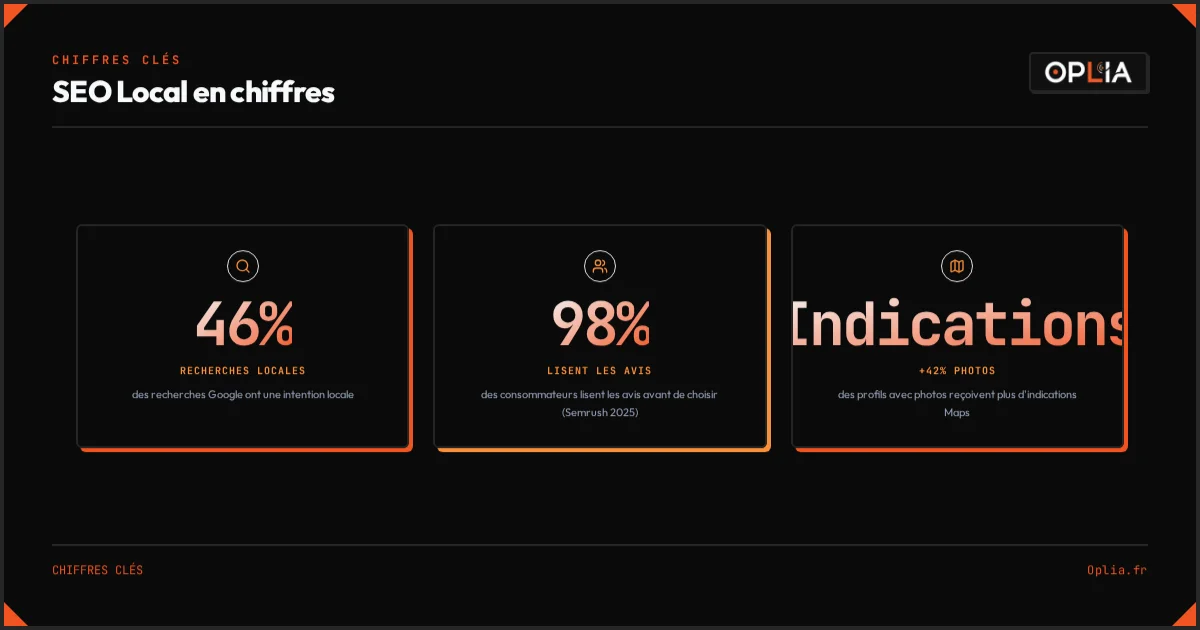
46% of searches on Google have local intent — that means nearly one in two searches is looking for a service or a business near them. And 76% of people doing a local search visit the business within the day (Google, 2024).
If you do not appear in these results, you are missing out on clients looking for exactly what you sell, in your area.
How the Local Pack works
The Local Pack is that block of 3 results with a map that appears when you search for “plumber Toulouse” or “hairdresser Saint-Orens”. Google selects the 3 most relevant listings according to 3 main criteria (Whitespark, 2026):
- Proximity — your address or service area in relation to the searcher
- Relevance — your category and keywords match the search
- Prominence — your online reputation (reviews, citations, backlinks)
“Local search resists the rise of generative AI surprisingly well, unlike informational SEO. Proximity and opening hours now dominate the Pack/Maps rankings — being open when the client searches has become as important as thematic relevance.”
— Whitespark, 2026 Local Search Ranking Factors (47 experts, 187 factors rated)
What this means for you: If you close at 5 PM and your clients search at 6 PM, even with a perfect listing, you will be less visible in the evening slot.
The 3 pillars of the Local Pack in 2026
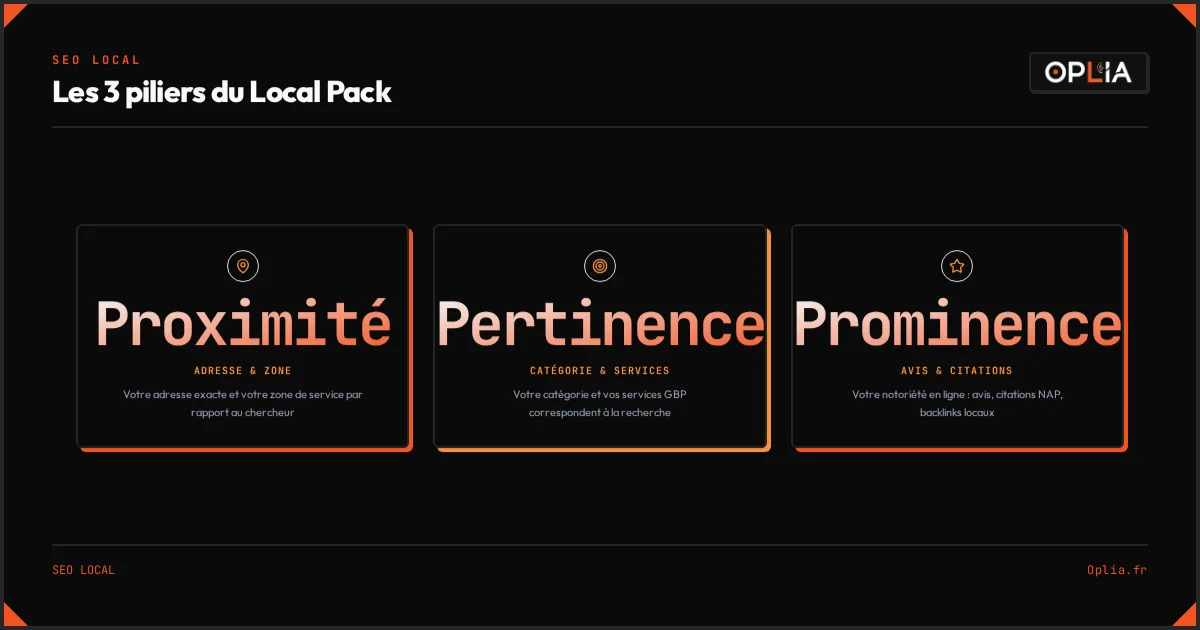
| Pillar | What counts | Estimated impact |
|---|---|---|
| Proximity | Exact address, correctly configured service area | Very strong |
| Relevance | Main category, keywords in description, GBP services | Very strong |
| Prominence | Reviews (rating, volume, recency), NAP citations, local backlinks | Strong |
Tip: The “Invisible Competitor Test” — type your trade + your city into Google. Note who appears in the Local Pack. Analyze their listing, their reviews, their categories. These are your targets for the next 3 months.
How to optimize my Google Business Profile listing in 30 minutes?
Your Google Business Profile (GBP) listing is your second showcase site. It is the first element Google looks at to decide if you are legitimate in your area.
The 6 priority actions (30 minutes flat)
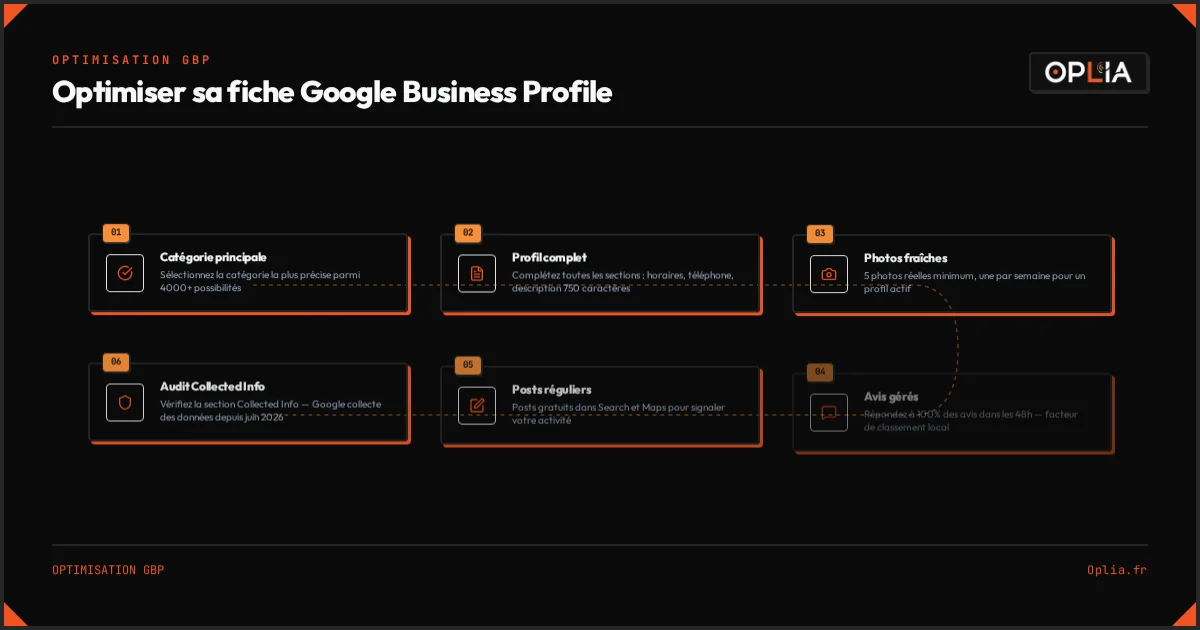
1. Check and correct your main category
This is the #1 factor in local ranking (Moz, Whitespark). Google offers 4,000+ categories. Choosing “Hairdresser” instead of “Hair Salon” can change 50% of your searches. Add relevant secondary categories.
2. Your name = your real name
No keywords added. “SARL Dupont Plumbing Toulouse” is not correct if your legal name is “SARL Dupont”. Google suspends listings that use keyword stuffing in the name.
What I learned in the field: A client had put “Plumbing Toulouse Emergency” in his name — his listing was suspended 3 days later. We reopened with the legal name, and put the keywords in the description and services. Result: same ranking, zero risk of suspension. The rule is clear: real name, no tricks.
3. Complete ALL sections
Profiles with photos receive 42% more directions requests on Google Maps and 35% more clics (Ahrefs). Mandatory sections:
- Exact hours (including holidays)
- Phone number
- Website
- 750-character description with natural keywords
- Services (the new “services” section directly feeds LLMs)
4. Publish one photo per week
Photo freshness is a signal of an active profile. Google favors profiles that publish regularly. No need for professional photos — photos of your real work, your team, your job sites are enough.
5. Activate GBP posts
Free publications in Search and Maps are a documented local ranking factor. Publish an offer, a recent project, or useful advice. One post per week is enough.
6. Check the “Collected Info” section
Since June 2026, Google displays a new “Collected Info” section in GBP listings. Automatically collected data (calls, SMS, WhatsApp) can be incorrect. Systematically check that the information is correct.
What Google checks in the background
Google cross-references 6+ sources to build your listing: aggregators (Infogroup, Axiom), crawled sites (Yelp, PagesJaunes), government data (INSEE, societe.com), Street View, and you via GBP. The owner is only ONE source. To correct a persistent error, correct it at ALL sources.
Are reviews really the #1 lever in 2026?
73% of online reviews are on Google. 98% of consumers read reviews before choosing a local business (Semrush, 2025). And since 2026, LLMs (ChatGPT, Perplexity, Google AI Mode) analyze the textual content of reviews to decide whether to recommend you.
What changed with AI
LLMs no longer settle for stars. They analyze the quality and sentiment of reviews (Moz, 2026). A detailed review like “Excellent work, fast intervention for my water leak, fair price” has more weight than a “Great!” without content.
“LLMs analyze emotional tone beyond stars. Three key signals: review quality and sentiment, volume and recency, and richness of text content. Detailed reviews with contextual keywords can outperform the website in LLM visibility.”
— Moz, study on the impact of reviews in AI answers (2026)
The 3 levers for a review strategy that works
- Collection rhythm > total volume. Whitespark studies confirm that review recency is a major factor. A burst of recent positive reviews can boost your Local Pack ranking for weeks.
- Respond to ALL reviews — within 48h. This is a proven local ranking factor. Thank for positive ones, respond professionally to negative ones. Google indexes your responses.
- Ask at the right time. The method that works: immediate request after the service (in person + SMS link), follow-up at D+3, QR code at the service point with routing (Google review if satisfied / private survey if dissatisfied).
Why are my NAP citations as important as my Google listing?
A NAP (Name, Address, Phone) citation is a mention of your business on a third-party site — directory, social network, partner site. Google considers the consistency of these citations as a reliability signal.
The golden rule: same NAP everywhere
62% of consumers would avoid a business with incorrect information (Semrush). If your phone or address differs between Google, PagesJaunes, and your site, Google doubts your legitimacy.
The 5 priority directories for France
- PagesJaunes — the most used in France for local SEO
- Google Business Profile — obviously
- Société.com (INSEE) — the reference public data
- Bing Places for Business — 3% of search, but a non-negligible audience
- Apple Business Connect — Apple takes its Maps seriously, and it’s free
How to build your citations
For each directory, create an account and enter EXACTLY the same information:
- Business name = legal name (no keywords)
- Address = same as on your Google listing
- Phone = same number everywhere
- Website = your site (only one, no variations)
- Hours = identical to your Google listing
Tip: Do a Google search for “your name your city” and look at the first 10 results. If you see different information on 2 different sites, correct them. Start with automatic directories (Infogroup, PagesJaunes) — these are the ones Google cross-references in priority.
What content and pages should I create on my site to be found locally?
Having a perfect Google listing without a site behind it is like having a shop window but no shop. The site is what transforms a Google visitor into a client.
Indispensable pages
A local homepage: Your city and your trade must appear naturally in the title, description, and content. No keyword stuffing — one sentence is enough.
A credible “About” page: Google values sites with a real author, a physical address, and visible contact information. Local grounding (chamber of commerce, address, phone) is an E-E-A-T signal.
Location pages (if you cover multiple areas): One page per city with unique content, not a copy of the homepage with just the city name changed. Talk about the specificities of each area, the projects you carried out there, the clients you serve there.
Technical signals that count
| Signal | Why it is important | What you can do |
|---|---|---|
| Schema LocalBusiness | Helps Google understand your activity | Add JSON-LD on your contact page |
| Mobile speed | 76% of local searches are on mobile | Test with PageSpeed Insights, compress images. I wrote a guide on why a slow site makes you lose clients. |
| Complete contact page | It’s the most visited page after the home | Add a Google Maps map, the form, the phone |
| Consistent hours | Must match those of your GBP listing | Check that site and listing say the same thing |
What I learned in the field: A client had 17 “city” pages with the same text. Google did not index them. We rewrote each page with real local projects — a page on Toulouse with 2 real jobs, a page on Montauban with 1 job, etc. Result: 6 pages indexed in 3 weeks, and 2 calls from prospects in areas he did not cover before.
Has the arrival of AI changed the rules of local SEO?
The short answer: yes, but less than you think.
What has not changed
A recent study on 19 local clients shows that AI traffic (ChatGPT, Perplexity, AI Overviews) represents less than 0.7% of traffic. The Google Local Pack generates 68 to 79% of conversions (field study, 2026).
“AI traffic is a myth for local SEO — 19 clients analyzed, less than 0.7% of traffic coming from AI, a 4-month test on a plumber = zero conversion. Do not reallocate your budget. The Local Pack generates 68 to 79% of real conversions.”
— Local SEO Field Study, 19 clients analyzed (2026)
What changes anyway
- LLMs cite sources outside the Google ranking. ChatGPT can recommend a business absent from the Google top 3 if it has detailed reviews and a complete profile on several platforms.
- The “services” section of your GBP feeds AI answers. Google uses your services (predefined and custom) to answer questions about your activity. The more detailed your services, the more chances you have of being cited. If you want to dig into this, I have an article on how to make your business appear in ChatGPT.
- Apple Business Connect becomes essential. Apple is actively developing its Maps with Siri AI. If you are not on Apple Maps, you are invisible to iPhone users searching by voice.
- Google Analytics integrates GBP data (June 2026). 7 new local metrics are available directly in GA4: calls, directions, messages, bookings, reviews, photos, posts. No more need for third-party tools to track your performance.
What are the errors that prevent you from being visible locally?
I see the same errors in almost all the audits I perform. Here they are, so you can correct them before losing clients.
Error #1: incomplete Google listing
This is the most common error. Missing hours, no photos, empty description, generic category. Google cannot recommend you if you do not give it the information.
Error #2: ignoring reviews (especially negative ones)
Not responding to a negative review is telling Google “I do not manage my reputation”. Respond professionally within 48h. A well-crafted response converts more prospects than a non-commented positive review.
Error #3: inconsistent information between site, listing, and directories
One number on your Google listing, another on PagesJaunes, a third on your site. Google detects the inconsistency and deprioritizes you.
Error #4: neglecting secondary categories
The main category is crucial, but additional categories open doors. A plumber who adds “water heater specialist” will appear on searches they wouldn’t have touched.
What I learned in the field: An electrician client had put “Electrician” as his sole category. Adding “Home Automation” and “Electrical Renovation” as secondary categories made his listing appear on 3 new queries in 2 weeks.
How to take action starting this week?
Here is the concrete checklist for the next 7 days. Each action takes less than 15 minutes.
Days 1-2: The Google listing
- Check that your GBP listing is well claimed and verified
- Choose the most precise main category possible
- Add 3 relevant secondary categories
- Complete hours, phone, website, description
- Add 5 recent photos of your work
Days 3-4: Reviews
- Respond to all unanswered reviews
- Set up a collection system (QR code, post-service SMS)
- Ask for 3 reviews from satisfied clients
Days 5-6: Site and directories
- Check that your NAP information is consistent on at least 5 sources
- Add LocalBusiness structured data to your site
- Create or optimize your contact page
Day 7: Follow-up
- Activate GBP notifications for new reviews
- Publish a GBP post (offer, project, tip)
Summary — checklist:
| # | Action | Done? |
|---|---|---|
| 1 | GBP listing verified and complete (hours, photos, description) | ☐ |
| 2 | Precise main category + 3 secondary ones | ☐ |
| 3 | Responded to 100% of reviews (last week) | ☐ |
| 4 | Review collection system in place (QR code or SMS) | ☐ |
| 5 | Consistent NAP information on 5 directories | ☐ |
| 6 | LocalBusiness Schema added to the site | ☐ |
| 7 | GBP post published this week | ☐ |
Interpret your score:
- 0-2: You are still invisible on Google. The potential for progress is huge — attack days 1-2 in priority.
- 3-5: You have the basics but a hole or two in the net. Prioritize what is missing — each unchecked point can represent clients slipping past you.
- 6-7: You have a solid foundation. Now look at what your competitors are doing: what is their category? their reviews? their city pages? Widen the gap on content and consistency.
Key Takeaways
- The Google Local Pack remains the #1 channel — 68 to 79% of conversions come from there. AI has not replaced local results.
- The GBP category is the most powerful lever — choose the most precise one possible, it determines 70% of your searches.
- Reviews are the trust signal of 2026 — velocity > volume, and respond to ALL.
- NAP consistency on at least 5 directories is the condition for Google to trust you.
- AI does not replace local SEO — it completes it. Keep your priorities: GBP, reviews, citations, local content.
Your Google listing is free. Your site already exists. Clients are searching for your trade in your city every day. The only difference between you and your competitor appearing in the 3 cards is the work you are willing to put in — or delegate.
To go further
- My website does not appear on Google: where to start? — The first 5 checks to do
- Why my website doesn’t bring me clients? — The invisible reasons for SMB digital failure
- Understanding E-E-A-T: the guide for SMBs — Why Google trusts some sites and not others
A Google listing without maintenance is a store whose window gets dirty. One post per week, one response to reviews, one photo — 10 minutes. Local SEO doesn’t cost much. Invisibility does.
Need local support? Discover our service areas across France.