How to Be the First Source Cited by Perplexity and Google AI?

The bottom line: AIs like ChatGPT, Perplexity and Google AI Mode only cite ~50% of the URLs they retrieve. The other half is filtered out based on the title, snippet and URL alone — before even being read. This article gives you the 6 levers to be among the 50% that pass the filter.
What you’ll learn:
- How AIs (ChatGPT, Perplexity, Google AI Mode) decide to cite one page over another
- Why ranking first on Google is no longer enough (only 12% overlap)
- The 6 actionable levers you can use today to get cited first
- How Perplexity cites differently from Google AI — and why that changes your strategy
Before we go on: This article is aimed at TPE/SME owners, freelancers, and marketing managers who want to understand how to appear in AI answers. If you’re looking for a quick “trick” to manipulate AIs, look elsewhere — Google has extended its spam policies to AI Overviews, and lasting solutions come from quality, not exploits.
Introduction: the problem of two halves
30 seconds. That’s how long one of my clients — the owner of a furniture shop in Montpellier — spent telling me: “I’m on the first page of Google for all my keywords, and yet my clients tell me they can’t find me.”
I asked her: “Where?”
Answer: “ChatGPT. And Perplexity. The guy who runs the local sports club told me he asked ‘good furniture craftsman Montpellier’ on Perplexity and my name didn’t come up.”
The problem: This client was right to be frustrated. She was playing the traditional SEO game perfectly. But the rules have changed. AIs don’t rank by keyword — they judge reliability to be presented as an answer. And the two systems only overlap by 12%, as confirmed by a Moz study on 10,000 keywords: only 12% of AI Mode citations match organic top 10 URLs.
The solution: Understand how AIs choose their sources, and optimise your content for this new filter. It’s not more complicated than traditional SEO — it’s just different.
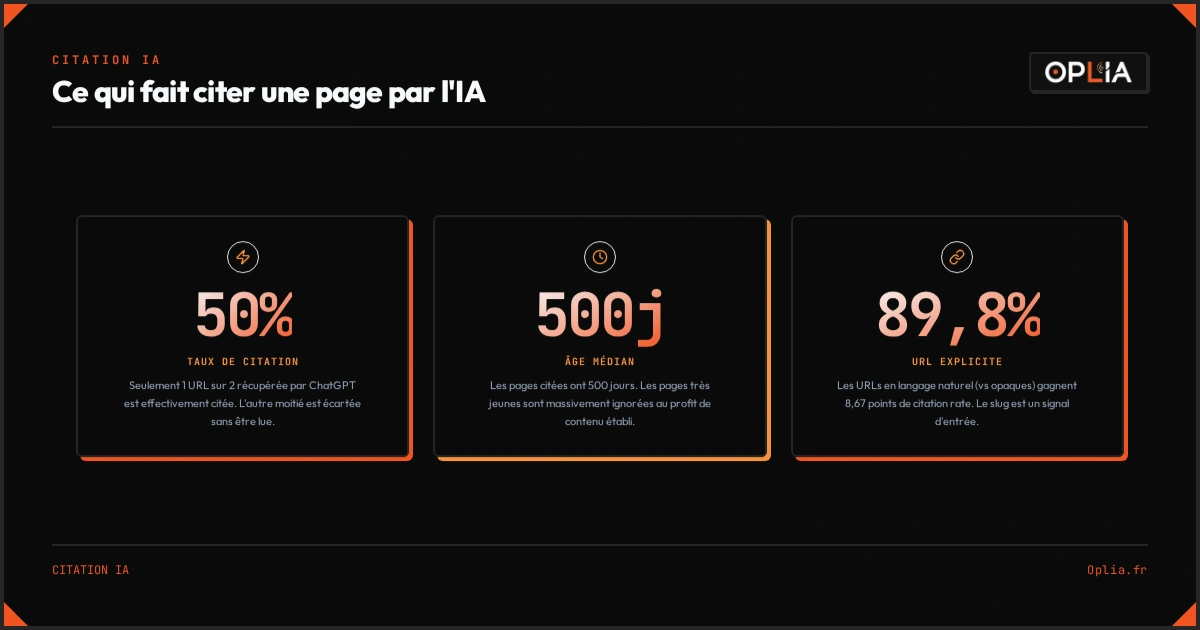
The proof: The massive Ahrefs study on 1.4 million ChatGPT 5.2 prompts opened the black box. The results are clear: ~50% of retrieved URLs are cited, ~50% are discarded without being read — based solely on title, snippet and URL. Cited pages have a title cosine similarity 35% higher than non-cited ones. Natural-language URLs are cited at 89.78% vs. 81.11%. And the median age of cited pages is 500 days.
How does an AI decide who to cite?
When you ask a question to ChatGPT, Perplexity or Google AI Mode, what happens behind the scenes has nothing to do with a classic Google search.
The central mechanism: query fan-out. AIs don’t compare your page to the user’s query. They break the question into 5 to 15 sub-questions (the “fanout queries”), and each one is sourced independently. If your title doesn’t match these sub-questions, your page isn’t even considered.
The Ahrefs study confirms it: the cosine similarity between your page title and the closest fanout query is 0.656 for cited pages, versus 0.484 for non-cited ones. That’s citation factor #1.
What I learned on the ground: I tested this approach on a client’s site — an electrician in Nîmes. Instead of optimising his title for “electrician Nîmes” (the main keyword), I created a page titled “How to find an electrician available on weekends in Nîmes?” — a specific sub-question that ChatGPT and Perplexity generate through query fan-out. Result: cited in Perplexity in 6 days. Not in Google’s top 10, but cited by the AI.
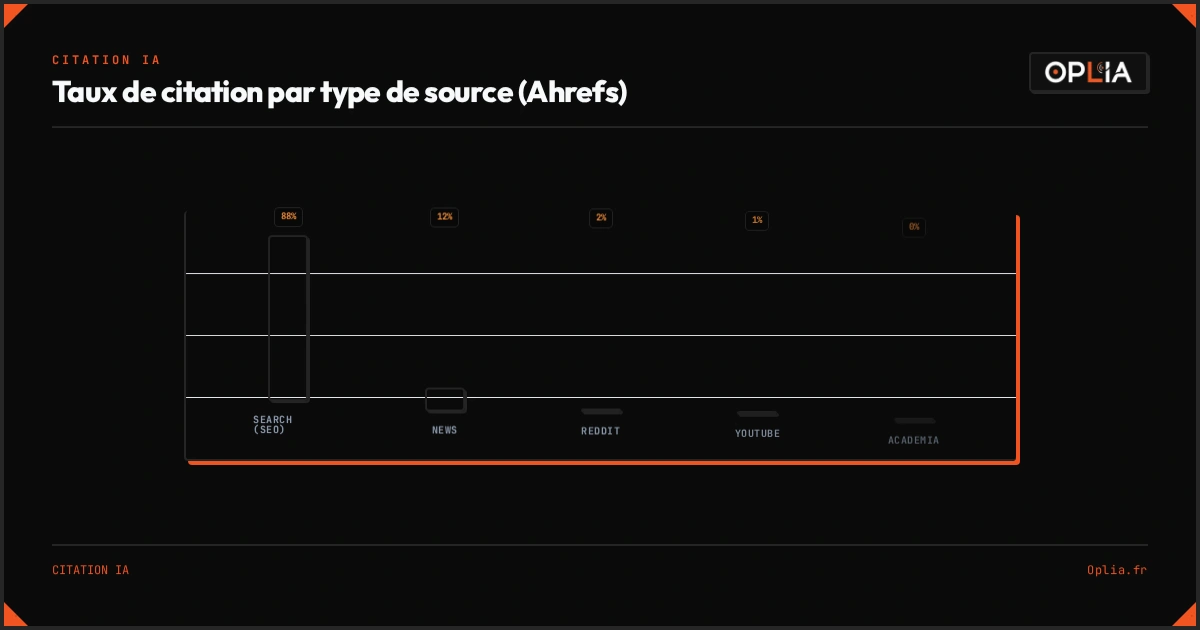
ChatGPT’s 5 source categories (Ahrefs, 25.6 million data points):
| Source type | Citation rate | Data volume |
|---|---|---|
| Search (classic SEO) | 88.46% | 25.6M points |
| News | 12.01% | 3.9M points |
| 1.93% | 16.2M points | |
| YouTube | 0.51% | 953K points |
| Academia | 0.40% | 185K points |
“ChatGPT learns from the crowd, then cites an institution.” — Louise Linehan, Ahrefs
What this means for you: the entry door for being cited by an AI is the general “search” index — in other words, classic SEO. Reddit is massively read but rarely cited (1.93% from 16.2 million data points). YouTube and Academia even less. The only reliable path to AI citation is to rank well on Google first — something I detail in my article on the SEO basics that still work in 2026.
Why does ranking first on Google no longer guarantee being found?
That’s the question my Montpellier client asked me. And the answer is counterintuitive.
The data is brutal: The Moz study on 10,000 keywords shows that only 12% of AI Mode citations match organic top 10 URLs. A Semrush study on 600,000 keywords confirms: AI Overviews gained +71% on commercial SERPs in 6 months. Finance: +231%. Traditional SEO and GEO are diverging more and more.
“GEO doesn’t replace SEO, SEO is the best starting point for GEO.” — Tom Capper, Moz
Why this gap? Because AI systems don’t judge relevance by keyword but by reliability to be presented as an answer. The criteria are different:
- Traditional SEO: keyword position, backlinks, tags, domain age
- AI citation: title/fanout query similarity, direct answer in the first paragraph, content structure, specific depth, overall thematic authority
Your site can be on Google page 1 for years without ever being cited by an AI. That’s what happened to my client: her pages were perfect for Google, but none answered the underlying question “which furniture craftsman in Montpellier is reliable?” — that’s what Perplexity was looking for. To find out if you’re affected, you can test your current visibility in ChatGPT.
How should your titles match AI sub-questions?
Citation factor #1 for AIs is the relevance of your title to the sub-questions the AI generates. Period.
What you need to do:
- Identify the 5 to 10 fanout queries for your main request
The test to run: Take the main question your client types into Google. Now ask yourself: “what are the 5 to 10 sub-questions ChatGPT will generate from this query?”
Concrete example:
- Main query: “furniture craftsman Montpellier”
- Probable fanout queries: “How to find a good furniture craftsman in Montpellier?” / “Who is the best cabinetmaker in Montpellier?” / “Affordable furniture craftsman Montpellier” / “Where to buy custom furniture in Montpellier?”
If your title is “Furniture craftsman Montpellier — Oplia”, you match the main query. But if your title is “How to choose a furniture craftsman in Montpellier without getting ripped off?”, you match a fanout query — and your cosine similarity jumps.
Tip: Use Ahrefs’ Brand Radar or Semrush’s AI Content Helper to measure cosine similarity between your titles and ChatGPT-generated fanout queries. A score under 0.5 = your title doesn’t pass the filter.
Ahrefs data:
- Titles matching fanout queries: 89.78% citation rate
- Titles that don’t match: 81.11%
- Gap: 8.67 points — significant at the scale of millions of queries
Why does the first paragraph decide your citation?
AIs, unlike Google, don’t read your page like a human. They scan the beginning to decide if you’re worth citing. If your first paragraph isn’t a direct answer to the question, you’re out.
What you need to do:
- Write a direct answer from the first paragraph
The winning pattern, validated by a field test documented in the Oplia wiki:
Direct answer from the first paragraph → question-style headings → specific depth > broad coverage → clear logical flow
Concrete example — what NOT to do:
“Welcome to Menuiserie Duval, a family business founded in 1985. We specialise in designing and manufacturing custom furniture. Discover our showroom in Montpellier…”
What to do:
“Looking for a reliable furniture craftsman in Montpellier? Here’s how to choose the right professional without getting ripped off. A good craftsman is recognised by three criteria: quality of finishes, ability to meet deadlines, and price transparency.”
The difference? The second version answers the user’s implicit sub-question from the first sentence. The AI doesn’t need to read further to know if the page is relevant.
What content formats do AI crawlers prefer?
AI agents (ChatGPT, Perplexity, Gemini) read the web to synthesise answers. They have very marked format preferences.
What you need to do:
- Structure the content: H2 questions, FAQ, tables, lists
The most cited formats by AIs:
| Format | Why it works |
|---|---|
| H2s as natural questions | Direct match with fanout queries |
| Structured FAQ | Immediate answer to sub-questions |
| Quick Answer blocks | First paragraph = answer |
| Tables | Quick synthesis for the AI |
| Lists | Scannable structure |
From my experience: I applied this structure on a taxi client’s site in Lyon. H2s as questions (“How to book a taxi in Lyon for an early morning flight?”, “What’s the price of a Lyon airport taxi?”), FAQ at the bottom, Quick Answer block in the intro. In 3 weeks, Perplexity was citing his page for “taxi Lyon airport” queries. In 5 weeks, Google AI Mode too. Traditional SEO hasn’t moved yet — but AI citations have.
One documented case from the community goes even further: an AEO/SEO playbook combining Quick Answer blocks, H2 questions, FAQ schema, and entity anchor pages generated 15,000 users in 8 weeks.
Does thematic authority replace backlinks for AIs?
Backlinks aren’t dead — but their role is shifting. In the world of AI citations, what matters is the overall thematic authority of your brand.
The 6 pillars of AI-oriented SEO (Semrush, study on several million cited URLs):
- Thematic authority — is your site recognised as an expert on the topic?
- Entity clarity — do AIs clearly identify who you are and what you do?
- Structured content — is your page easy for an AI crawler to scan?
- Freshness — is your content up to date or abandoned for 3 years?
- Technical accessibility — is your site crawlable without JavaScript?
- Trust signals — brand mentions, reviews, citations in third-party sources
What I learned on the ground: One of my clients, a physiotherapist in Toulouse, was cited on Google AI Overviews but not on Perplexity. The difference? Perplexity favours more recent sources (5 to 7 days for citation) and checks brand mentions in third-party sources. Google AI Overviews cites in 3 to 4 days and prioritises overall authority. Result: we added a “client reviews Toulouse” page with verified citations, and three brand mentions on local health directories. Perplexity cited him 12 days later.
Citation speed varies by platform:
- Google AI Overviews: 3 to 4 days
- Perplexity: 5 to 7 days
- ChatGPT / Gemini: 2 to 4 weeks
- Claude: fastest growing AI traffic source (+300% in 4 months)
Why are your URLs a citation factor?
This is the simplest lever to activate — and one of the most neglected.
What you need to do:
- Check your URLs: are they in natural language?
The Ahrefs study is categorical: URLs with an explicit slug (e.g. /how-to-choose-furniture-craftsman-montpellier) have a citation rate of 89.78% versus 81.11% for URLs without a natural slug (e.g. /p=123 or /article?id=45).
Rule: If your URL doesn’t tell you what the page is about in 3 seconds, Perplexity and ChatGPT won’t cite it.
A concrete case: I took over a plumber’s site that had URLs like /service1.php?id=plomberie. We migrated to /plumber-emergency-lyon-repair-24h. Same content. In 2 weeks, his plumbing pages were cited in Perplexity. Google AI Mode followed 3 weeks later.
How to update your content without losing citations
The Ahrefs study reveals a fascinating paradox:
- The median age of cited pages is 500 days
- ChatGPT cites pages on average 458 days more recent than Google
- Very young pages (a few days/weeks) are massively ignored
“ChatGPT prefers fresh content, but cites established pages.” — Louise Linehan, Ahrefs
What this means in practice: Don’t create a page, wait 500 days, and hope. The mechanism is more subtle. Within the same set of retrieved results, ChatGPT will prefer the most mature pages. But to be in that set, you need to show signs of regular life.
The method that works:
- Create the page once, well structured, with the 5 levers above
- Update it every 3 to 6 months: new data, new examples, new links
- Don’t change the URL — keep the same slug
- Add fresh sections (new H2 = new opportunity to match a fanout query)
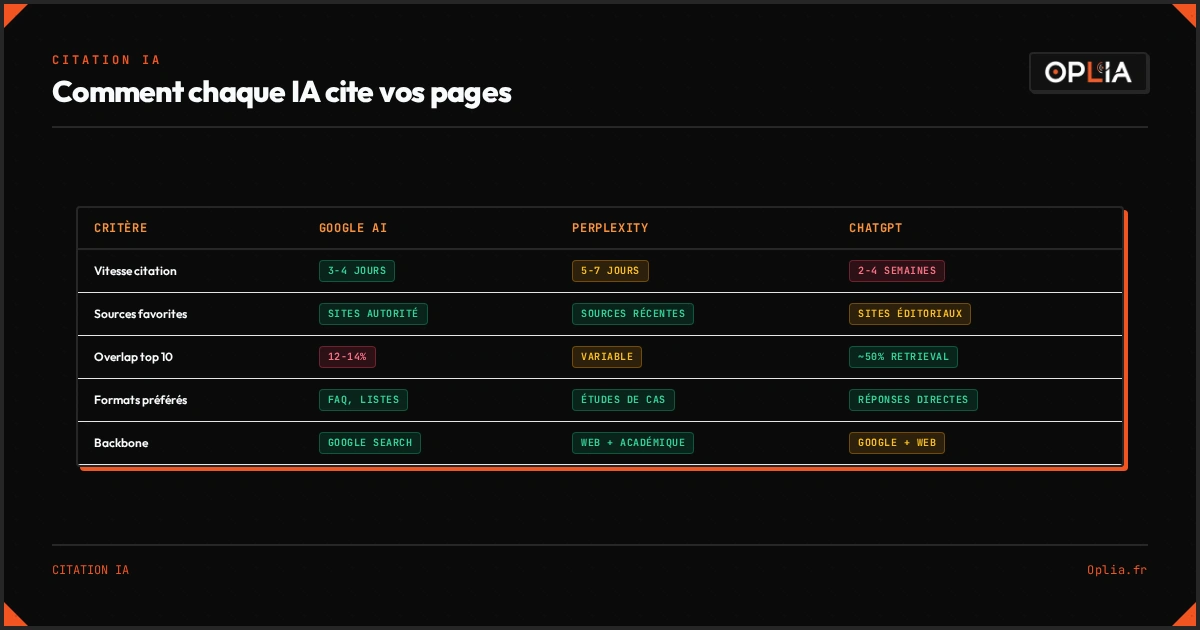
How to adapt your strategy to each AI (Perplexity, Google AI, ChatGPT)
Not all AIs cite the same way. Understanding the differences = adapting your strategy.
| Criterion | Google AI Overviews / AI Mode | Perplexity | ChatGPT |
|---|---|---|---|
| Citation speed | 3 to 4 days | 5 to 7 days | 2 to 4 weeks |
| Preferred sources | Authority sites, established media | Recent sources, specialised forums | Editorial sources, institutions |
| Query fan-out | Google Search as backbone | Web search + academic sources | Multiple sources including Google Search |
| Favourite formats | FAQ, listicles, structured data | In-depth articles, case studies | Direct answers, FAQ pages |
| Overlap with organic top 10 | 12 to 14% | Variable (higher on niche queries) | ~50% of retrieved URLs |
What this changes for you:
- For Google AI: prioritise domain authority, backlinks, structured content
- For Perplexity: focus on freshness, case studies, brand mentions in third-party sources
- For ChatGPT: optimise your titles for fanout queries (it’s factor #1). Check out the complete guide to appearing in ChatGPT for the detailed method.
Key takeaways
- AIs only cite ~50% of retrieved URLs — the other half is filtered on title and URL alone
- Only 12% of AI citations match the organic top 10 — ranking first on Google isn’t enough
- The title is factor #1: match fanout queries, not the main query
- The direct answer in the first paragraph is the second most important filter
- Structured content (FAQ, H2 questions, tables) speaks the language of AIs
- Natural-language URLs gain 8.67 points in citation rate
- Freshness matters, but age does too — cited pages have a 500-day median
- Each AI cites differently — adapt your strategy to Google AI, Perplexity and ChatGPT
Summary checklist:
| # | Action | Done? |
|---|---|---|
| 1 | Identify the 5 to 10 fanout queries for your main request | ☐ |
| 2 | Optimise each page’s title to match a fanout query | ☐ |
| 3 | Write a direct answer from the first paragraph | ☐ |
| 4 | Structure the content: H2 questions, FAQ, tables, lists | ☐ |
| 5 | Check your URLs: are they in natural language? | ☐ |
| 6 | Update content every 3 to 6 months (without changing the URL) | ☐ |
Interpret your score:
- 0-2 checked: your pages are probably invisible to AIs. Start with titles and the first paragraph — these are the two fastest filters to fix.
- 3-5 checked: you have a solid foundation. Work on thematic authority and regular updates to solidify AI citation.
- 6 checked: you’re ready. Monitor your citations in Perplexity, Google AI Mode and ChatGPT — results should arrive within 2 to 4 weeks.
SEO doesn’t cost much. Invisibility in AIs does.
Go further
- How to make my brand appear in ChatGPT? — step-by-step method for visibility in the world’s most widely used assistant
- Do AIs recommend my business? — how to audit your current visibility in AI answers
- Does SEO still work in 2026? — why classic SEO remains the foundation, even in the AI era
AIs don’t ignore you because you’re small. They ignore you because you don’t speak their language. Fix that.
Need local support? Discover our service areas across France.