How to Be Visible on Google AND Cited by AI at the Same Time?
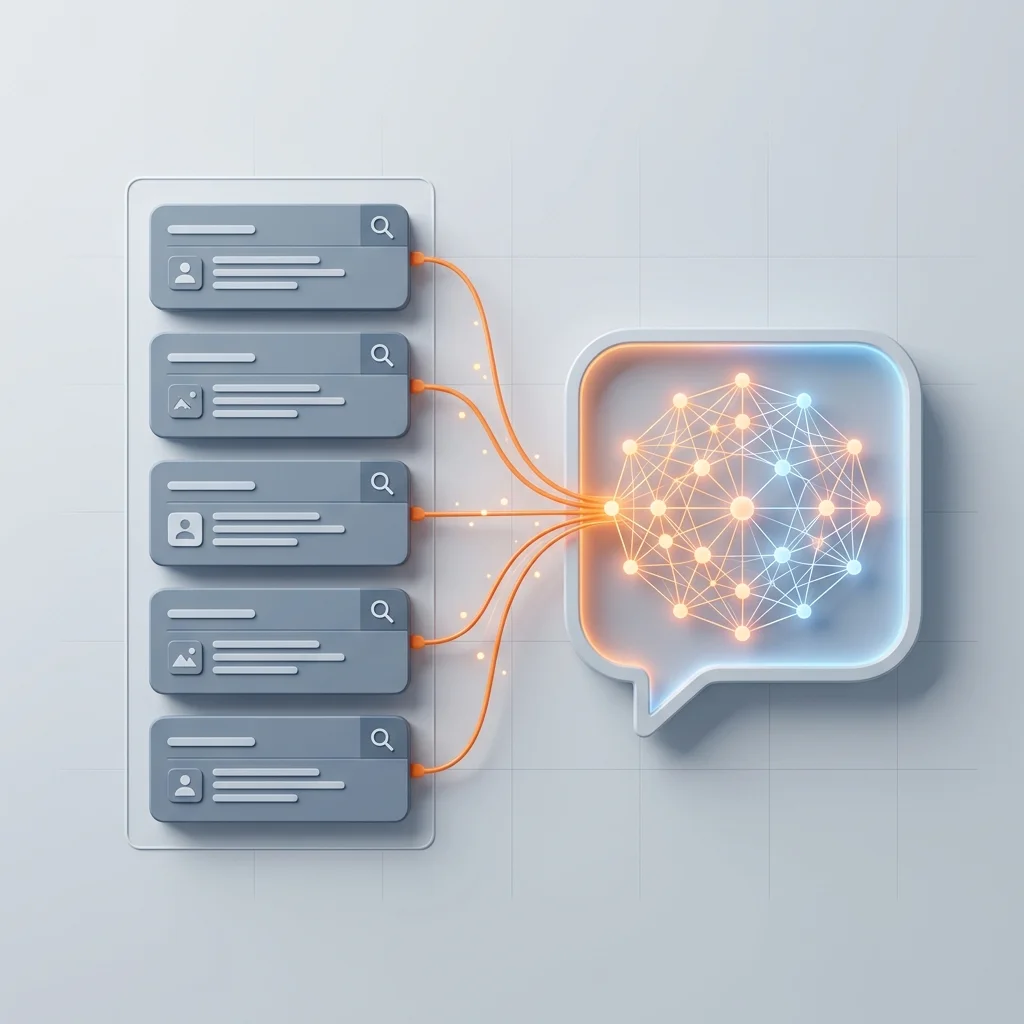
The bottom line: SEO and GEO are not in competition. 88% of AI citations don’t come from the Google top 10, but without technical SEO, AIs can’t even read your site. The method for being visible everywhere is a solid technical foundation + content structured as Q&A — not two sites, not two strategies.
What you’ll learn:
- Why being #1 on Google no longer guarantees AI citations
- The 6 common levers that serve both SEO and GEO
- The step-by-step method to optimize without starting over
- What’s a waste of time (and costing you money)
Before you continue: This article is for owners of very small and medium-sized businesses who have a website, who may appear on Google, but who are noticing that their customers aren’t finding them like they used to. If you don’t have a website yet, start there — SEO and GEO are useless without a functional technical foundation.
In early 2024, I was working with a plumber in Toulouse. His site was ranked third on Google for “plumber Toulouse.” A seemingly perfect result. Yet when his prospects asked ChatGPT the same question, he never appeared. Not once. The AI was citing pages from companies he didn’t even know.
The problem: This craftsman was going to lose customers simply because his site was invisible to generative AIs — even though it ranked well on Google.
The solution: I kept his SEO intact and added a layer of optimization for AIs. Within 6 weeks, he was cited by both Google and ChatGPT. Without rebuilding his site, without doubling his budget.
The proof: This case isn’t isolated. The data is clear: AIs don’t draw from the same pool as Google. But both share the same foundations.
Table of Contents
- Why is my site #1 on Google but missing from ChatGPT?
- Should I choose between SEO and GEO to be visible on AI engines?
- How do I optimize my site for both Google and AI?
- Where do I actually start optimizing my site for AI?
- Which SEO optimizations waste time with AI search engines?
- Key takeaways
- Going further
Why is my site #1 on Google but missing from ChatGPT?
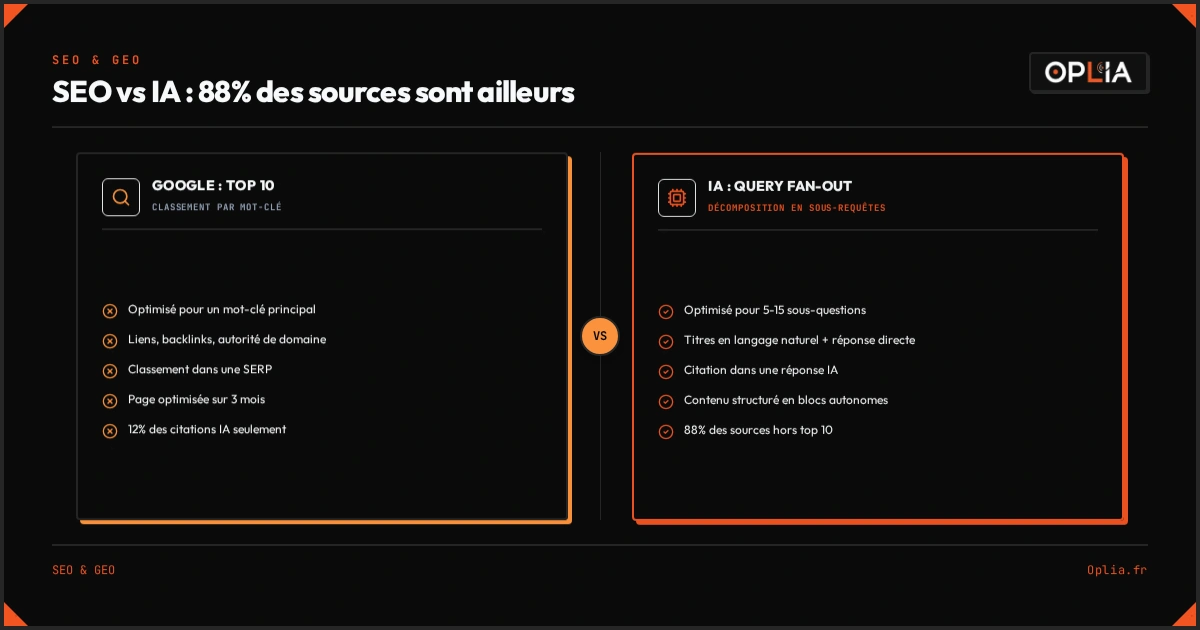
The answer boils down to two figures: 12% and 88%.
A Semrush study analyzed 40,000 keywords comparing Google AI Mode citations with traditional organic results. Findings: only 12% of AI citations match URLs from the organic top 10 (Semrush, 2026). In other words, 88% of the sources the AI uses to answer aren’t in the Google top 10.
Yet the reality is quite different: the AI doesn’t just duplicate Google’s results.
Note: I audited a client’s site that was #1 on Google for “Lyon personal trainer.” Three ChatGPT queries later, the AI was citing two competitors and a general blog article. The client was #1 on Google and completely invisible in AI. The mistake? Their content was optimized for one keyword, not for a network of questions.
This mechanism is called query fan-out. When you ask an AI a question, it breaks it down into 5 to 15 independent sub-queries. For each one, it finds the best source. If your page perfectly covers one keyword but misses the sub-questions, the AI moves on. As Backlinko explains in their analysis:
“A site can be #1 on Google and never be cited by an AI if its pages don’t cover the sub-questions.” — Backlinko (Backlinko, 2026)
Should I do SEO or GEO to be visible on AI engines?
You shouldn’t have to choose. Google itself has settled the matter.
Gary Illyes (Google) confirmed that AI Overviews use the same ranking systems as traditional search: the same crawling, same indexing, same signals (Google Search Central, 2026). If your site isn’t technically sound (crawler blocked, not indexed, slow loading), the AI won’t see it either.
In July 2026, Google integrated AI visibility into Search Console — within the same tool, with no product distinction. Slobodan Manic (ex-Ahrefs) puts it perfectly:
“Those still paying for a separate GEO practice are optimizing for a distinction Google just abolished.” — Slobodan Manic, former SEO expert at Ahrefs (Search Engine Journal, 2026)
Google’s message is clear: AI is not a separate discipline, it’s an extension of traditional search.
However, SEO alone is not enough to guarantee citations. Studies confirm this: the overlap between organic sources and AI sources is only 12 to 14%. AIs add their own requirements: title phrasing, content structure, direct answers, thematic authority.
“GEO doesn’t replace SEO, SEO is the best starting point for GEO.” — Tom Capper, SEO analyst at Moz (Moz, 2026)
What this means practically: If you only do SEO, you’ll be visible on Google but absent from ChatGPT. If you only do GEO, AIs will cite you but your site will remain technically fragile. Both approaches are complementary. Rather than launching two separate projects, we run a single initiative to meet both requirements.
How do I optimize my site for both Google and AI?
Good news: the same foundational pillars serve both engines. Here are the six levers validated by data and our field experience.
1. Content that directly answers a specific question
Google rewards pages that precisely match search intent. AIs, meanwhile, favor content that delivers the answer right in the first paragraph, with no detours or unnecessary introductions.
An Ahrefs study of 1.4 million ChatGPT 5.2 queries confirms this: natural language titles aligned with AI sub-questions achieve an 89.78% citation rate, versus 81.11% for classic SEO titles (Ahrefs, 2026). This eight-point gap demonstrates the critical impact of this optimization.
What we do in practice: On every strategic page, we identify the main question and write the direct answer in the first paragraph. The detailed development comes after.
2. Titles that look like what a human would type into ChatGPT
Ahrefs’ study identifies cosine similarity between a page’s title and the AI’s sub-question as one of the most decisive citation factors. Structuring your titles as conversational queries directly increases your chances of appearing in answers.
3. Self-contained section structure (each H2 = one answer)
AIs don’t analyze your pages like human readers: they break them into blocks. Each H2 section becomes a candidate for citation. If a paragraph depends on previous section context to be understood, the AI will discard it.
Winning format: Each H2 must be self-sufficient and deliver complete value. This structuring principle is called content chunking (Semrush, 2026).
4. Thematic authority (backlinks + mentions)
Both AIs and Google rely on domain authority to assess trustworthiness. A site with quality backlinks, brand mentions on other platforms, and media citations will be indexed and cited much faster.
The BrightEdge 2026 study confirms: AI engines assign distinct roles to sources based on perceived authority (BrightEdge, 2026). High-authority sites are overrepresented in AI answers.
5. A technically sound site (crawlable, fast, no blocking JS)
This is the essential prerequisite. If Googlebot can’t crawl your site, ChatGPT’s bots won’t be able to either. Additionally, excessive loading time drastically reduces your citation chances.
| Technical requirement | Why it’s critical |
|---|---|
| Full indexing | Without indexing, neither Google nor AI can discover your pages. |
| Speed (LCP ≤ 2.5s) | Google and AI engines penalize slow sites. |
| No blocking JS | AI crawlers (GPTBot, ClaudeBot) don’t execute heavy JavaScript. |
| Working mobile version | Google’s mobile-first index also applies to AI extraction. |
| Structured data | Helps understanding but isn’t sufficient on its own. |
6. Regular updates
Content freshness is a strong signal for both Google and AI. All else being equal, a page unchanged for two years will be passed over in favor of a recently updated one.
Where do I actually start optimizing my site for AI?
If you already have a website, follow this proven roadmap from our client work:
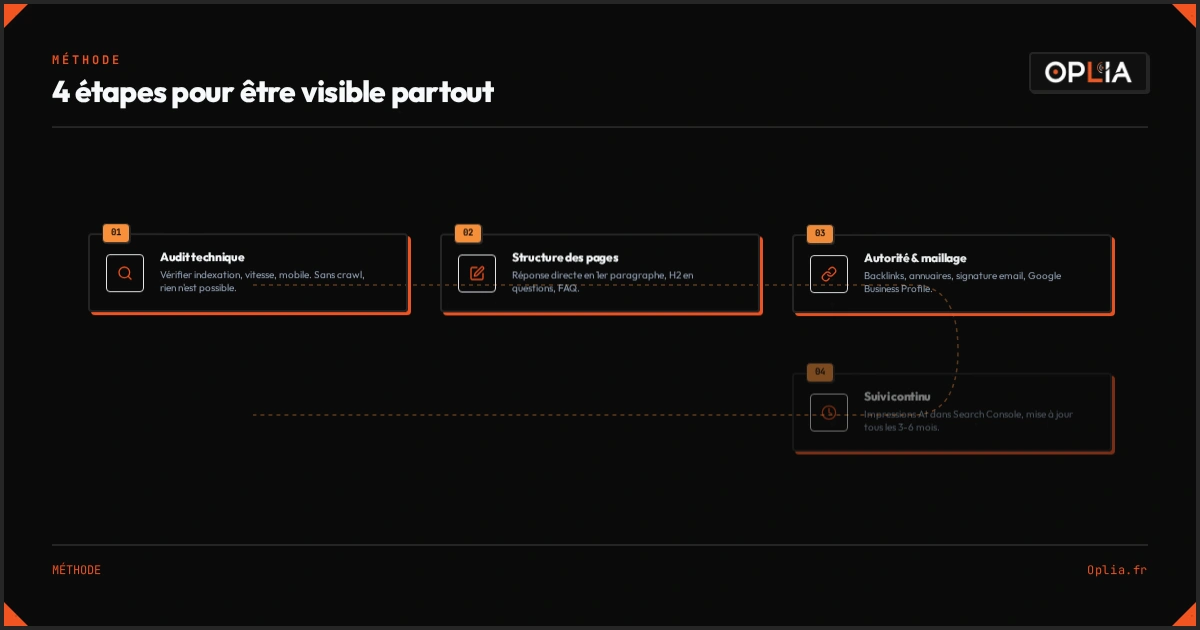
Step 1: Technical audit (weeks 1-2)
Before optimizing your content, make sure your site is technically healthy. Google Search Console provides indexing status for free, while PageSpeed Insights evaluates your Core Web Vitals. If your technical score is below 50/100, this is your priority.
- Run a Google Search Console diagnostic (indexing, crawl errors)
- Test pages on PageSpeed Insights (LCP ≤ 2.5s, INP ≤ 200ms, CLS ≤ 0.1)
- Verify the site is crawlable without JavaScript (disable JS in your browser)
- Remove obsolete extensions or scripts slowing down loading
Note: During one engagement, a client had a good-looking site, quality content, and solid backlinks. Yet they remained invisible on ChatGPT and Google AI. Analysis revealed their WordPress site loaded 23 plugins, resulting in a 7-second load time that blocked crawlers. After three weeks of technical cleanup, the site began being regularly cited by AIs.
Important: Content is useless if search engines can’t crawl it.
Step 2: Restructure existing pages (weeks 3-4)
Don’t rewrite everything. Focus on your 3 to 5 main pages by integrating GEO requirements.
- Add a direct answer in the first paragraph of each strategic page
- Rewrite H2s as direct conversational questions
- Add a 3-5 question FAQ at the bottom of the page
- Set up coherent internal linking between these pages
Step 3: Linking and authority (weeks 5-12)
- Update business profiles on professional directories (Societe.com, PagesJaunes)
- Add your site link to email signatures, quotes, and invoices
- Publish a guest article or get a citation on a partner site
- Optimize your Google Business Profile
Step 4: Ongoing monitoring (continuous)
- Monitor AI impressions in Google Search Console (via the Generative AI report)
- Check ChatGPT citations monthly
- Update pages every 3 to 6 months to maintain content freshness
Tip: Google Search Console now shows your impressions in AI Overviews and AI Mode. To track ChatGPT and Perplexity, you can use specialized tools like Semrush’s AI Visibility Toolkit (Semrush, 2026).
| # | Action | Done? |
|---|---|---|
| 1 | Run a Google Search Console diagnostic | ☐ |
| 2 | Test speed with PageSpeed Insights | ☐ |
| 3 | Verify my site is crawlable without JavaScript | ☐ |
| 4 | Remove unnecessary plugins/scripts | ☐ |
| 5 | Add a direct answer in the first paragraph | ☐ |
| 6 | Rewrite H2s as natural questions | ☐ |
| 7 | Add a 3-5 question FAQ | ☐ |
| 8 | Create internal links between main pages | ☐ |
| 9 | Update business profiles on directories | ☐ |
| 10 | Add my site to email signatures, quotes, invoices | ☐ |
| 11 | Complete my Google Business Profile | ☐ |
| 12 | Monitor AI impressions in Search Console | ☐ |
| 13 | Check whether ChatGPT cites my site (monthly) | ☐ |
| 14 | Update my pages every 3-6 months | ☐ |
Evaluate your progress:
- 0 to 3 actions completed: Focus on the technical audit first to unlock your visibility.
- 4 to 8 actions completed: The basics are solid. Now work on page structure and authority.
- 9 to 14 actions completed: Your site is on the right track. Set up regular monitoring and plan your next updates.
Which AI optimizations are useless and waste time?
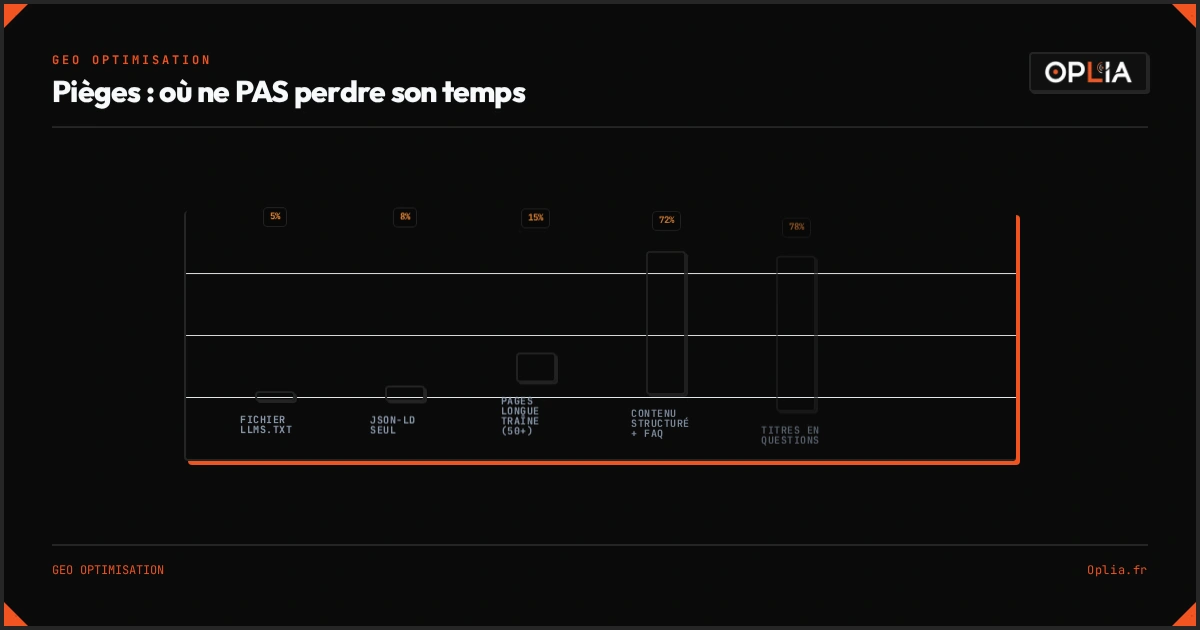
1. The llms.txt file. Although sometimes suggested, this standard isn’t stable yet and many crawlers ignore it. Spending time on it at this stage is unnecessary.
2. Structured data markup as a magic bullet. An Ahrefs study of 1,885 pages shows that adding JSON-LD doesn’t significantly increase citations (AI Overviews: -4.6%, AI Mode: +2.4%, ChatGPT: +2.2%) (Search Engine Journal, 2026). Markup helps understanding but remains secondary to structural quality.
3. Mass-producing ultra-specific content. Aligning with search intent is essential, but churning out low-value pages for every keyword variant is ineffective. The sources AIs select remain volatile: only 9.2% of links are reused from one similar query to another (SE Ranking, 2026). Prioritize a few thorough, solid pages over a multitude of shallow ones.
Key takeaways
- SEO and GEO are complementary: Google now integrates AI visibility directly into Search Console.
- Citations beyond the top 10 matter: 88% of sources cited by AIs are not in Google’s top 10 results.
- Shared requirements: Both approaches rely on structured content, query-style titles, and strong domain authority.
- Technical foundation first: Without indexing and loading speed, no visibility is possible.
- Incremental optimization: Integrate these adjustments into your existing structure without rewriting your entire site.
You don’t need to choose between Google and AI. You need a foundation that serves both.
SEO doesn’t cost much. Invisibility does.
Going further
- How to Make My Brand Appear in ChatGPT? — The basics of GEO
- What is GEO and How Do AIs Decide to Recommend My Business? — The complete GEO guide
- Is My Website Well Built to Be Visible on Google? — The technical audit to run first
Need local support? Discover our service areas across France.