Can Automation Replace My First Employee?
The bottom line: A first employee at the French minimum wage costs €25,000 to €30,000 per year in total employer cost. A targeted automation starts at €400 and costs less than €200 per month in hosting and maintenance. For a small business, the most profitable approach is to automate repetitive workflows first, so that your first hire arrives into an already structured, productive organization.
What you’ll learn:
- The full calculation of a first employee’s real cost in 2026 (beyond the gross salary)
- What automation can concretely take over — and its hard limits
- A costed hiring vs. automation comparison across 3 real small-business cases
- A 3-step decision framework to decide without hesitation
Before you continue: This article is for small business owners (0 to 5 employees) torn between hiring and automating. If you already manage a team of more than 10 people with middle managers, your organizational trade-offs are different.
Published August 12, 2026
In my previous career as a truck driver, when the schedule overflowed, the question came up fast: “do I hire a second driver or do I rethink my organization?” Today, with Oplia, I work with small business owners facing exactly this dilemma. Except that in 2026, a third option has emerged.
The problem: a small business owner working 60 hours a week has to delegate to survive. But the first hire is a financial and administrative commitment often underestimated by 20 to 50%.
The solution: this article lays out the real numbers, concrete use cases, and a step-by-step method to calmly decide between hiring and automation.
Table of Contents
- How Much Does a First Employee Really Cost in France in 2026?
- What Can Automation Do Instead of an Employee?
- What Can Automation NOT Do?
- How Much Does Automation Cost Compared to Hiring?
- How Do You Know If Your Business Is Ready for One or the Other?
- Key Takeaways
- Going Further
How Much Does a First Employee Really Cost in France in 2026?
An employee at the French minimum wage (SMIC) takes home about €1,443 net per month (Service-Public.fr). The gross monthly SMIC stands at €1,823.03 for a 35-hour week. But the total cost for the company reaches €2,000 to €2,400 per month, even after the general degressive reduction in employer contributions that replaced the old Fillon scheme. Without this relief, the total burden would exceed €2,900 per month.
And that figure only covers the direct loaded compensation. The overall annual cost for a small business necessarily includes several additional line items:
| Expense item | Annual estimate |
|---|---|
| Loaded gross salary (including employer contributions) | €24,000 to €28,800 |
| Mandatory company health insurance (min. 50% employer share) | €600 to €1,200 |
| Occupational medicine and fitness visits | €100 to €200 |
| Work equipment (desk, laptop, software licenses) | €1,500 to €3,000 |
| Onboarding and initial training time | €500 to €2,000 |
| Recruitment costs (job posting, screening) | €500 to €1,500 |
| Real annual total | €25,000 to €30,000 |
The Urssaf hiring cost simulator confirms that the net salary paid to the employee represents only about 60% of the employer’s total annual outlay.
What I learned in the field: a building trades craftsman I work with near Albi thought he could hire someone for €1,500 a month. That was the number in his head. When I showed him the real cost exceeded €2,100 with contributions, health insurance, and equipment, he put his pen down. We set up custom automation solutions for his quote follow-ups and invoicing instead. Result: 8 hours freed per week for €800 invested once.
And the hidden costs
Beyond the accounting line item, bringing in a first employee creates decisive organizational costs:
- Daily management: an employee needs regular supervision. Count 5 to 10 hours per week for instructions, checking, and debriefing. That time is no longer spent on production or business development.
- Legal and administrative responsibility: an error in the DSN (the French monthly social security declaration) or a late hiring formality exposes the company to financial and administrative penalties.
- Operational vulnerability: in the event of sick leave, extended vacation, or an unexpected resignation, the operational tasks fall entirely back on the owner.
None of these costs show up on the gross payslip, but they weigh directly on the day-to-day profitability of a very small business.
What Can Automation Do Instead of an Employee?
Software automation proves remarkably effective as soon as processes rely on explicit rules and recurring volume.
High-volume repetitive tasks
Any task that consists of extracting information, structuring it, and routing it to a third-party tool is a perfect target:
- Systematic follow-up on unpaid invoices: a workflow checks your bank balances and invoices every morning, sends a polite email reminder at D+1 past due, a second one at D+7, and creates an alert in your inbox at D+30 if the debt is still open. Cost: €400 once, €0 per month in marginal cost. I detailed this case in a dedicated article.
- Data entry and archiving of accounting documents: optical recognition of a purchase invoice received by email, accounting allocation in your spreadsheet or pre-accounting tool, and filing of the PDF in the right cloud folder.
- Qualifying and routing incoming emails: semantic analysis of incoming requests, categorization by urgency level, and generation of a personalized draft reply for standard inquiries.
The official France Num portal notes that deploying targeted automations and digital assistants on administrative workflows lets small business owners reclaim several hours of work per week while drastically reducing processing delays.
Reporting and operational monitoring
Another source of efficiency: dashboard consolidation. A workflow connected to your invoicing tool, your web analytics tool, and your contact forms can compile and send you a weekly summary every Monday at 8:00 AM, without any manual action. This manual summary work, which used to absorb 4 hours every weekend, now runs in seconds. This is the approach I explain for automating your administrative tasks.
Continuous prospecting and lead handling
On the sales side, enrichment and follow-up flows automate with great consistency. An automated scenario can detect new qualified prospects, enrich their business contact details, schedule a multichannel outreach sequence, and automatically insert positive replies straight into the owner’s calendar. The owner only gets involved at the sales meeting stage, freed from raw cold prospecting.
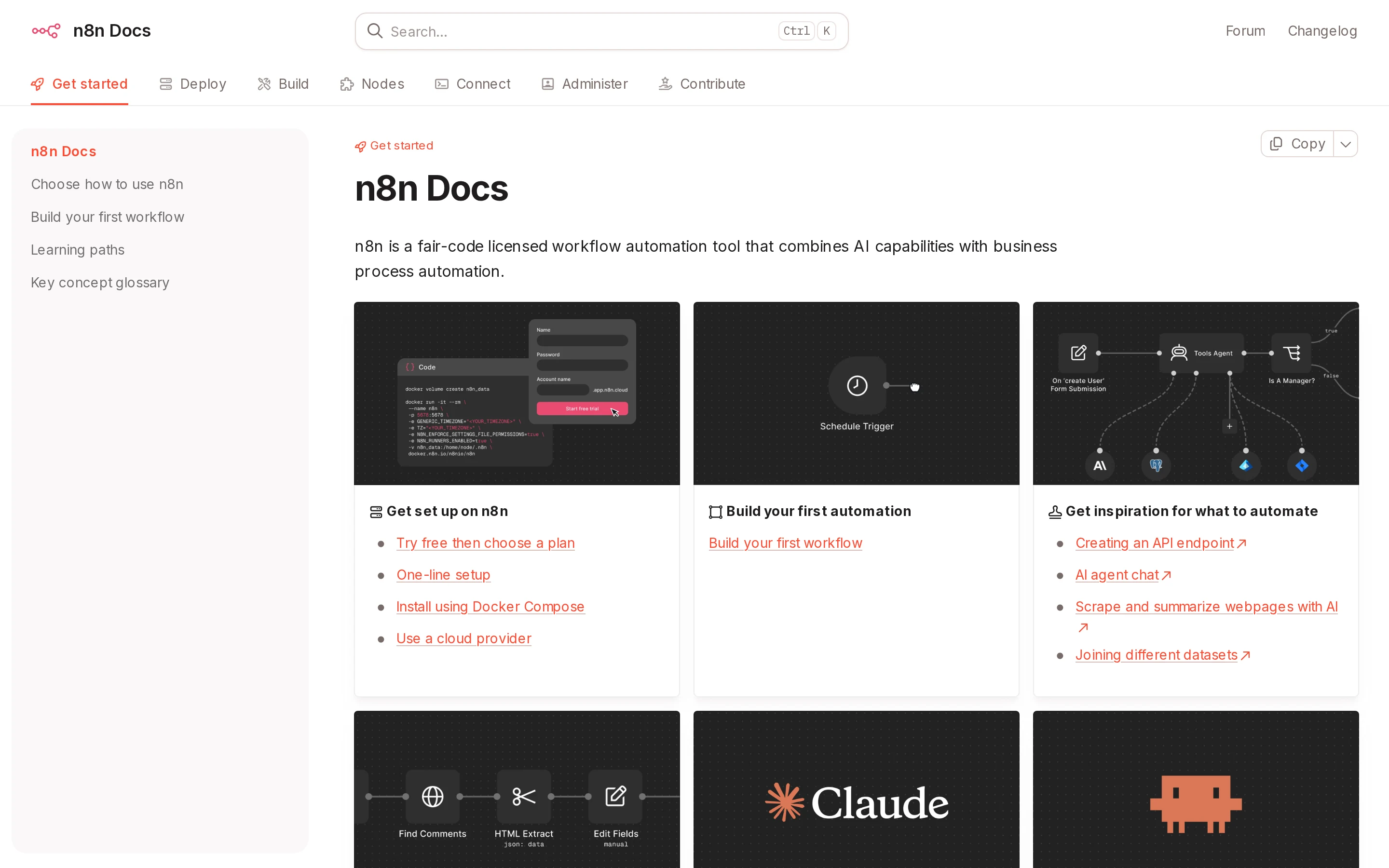 The open-source platform n8n lets you build and deploy interconnected visual workflows without coding.
What Can Automation NOT Do?
Software automation has strict boundaries that must be respected to preserve service quality:
Judgment in unprecedented situations. Faced with a complex complaint or an unexpected commercial dispute, the algorithm has no intuition. It can prepare the file and retrieve the exchange history, but active listening and negotiation remain the preserve of humans.
High-stakes client relationships. A strategic 45-minute conversation to understand the deep expectations of a key account and build trust cannot be left to a machine. Automation prepares the data, but human empathy closes the sale.
Adaptability on unstable processes. If a working method changes every week, creating and maintaining automated scenarios will cost more than handing the execution to a person. A simple guiding rule: if a task cannot be formalized into 5 stable, documented steps, it should not be automated.
“Critical business processes require deterministic logic combined with human-supervised AI agents rather than fully autonomous systems.” — Jan Oberhauser, founder and CEO of n8n (n8n agentic workflows guide)
How Much Does Automation Cost Compared to Hiring?
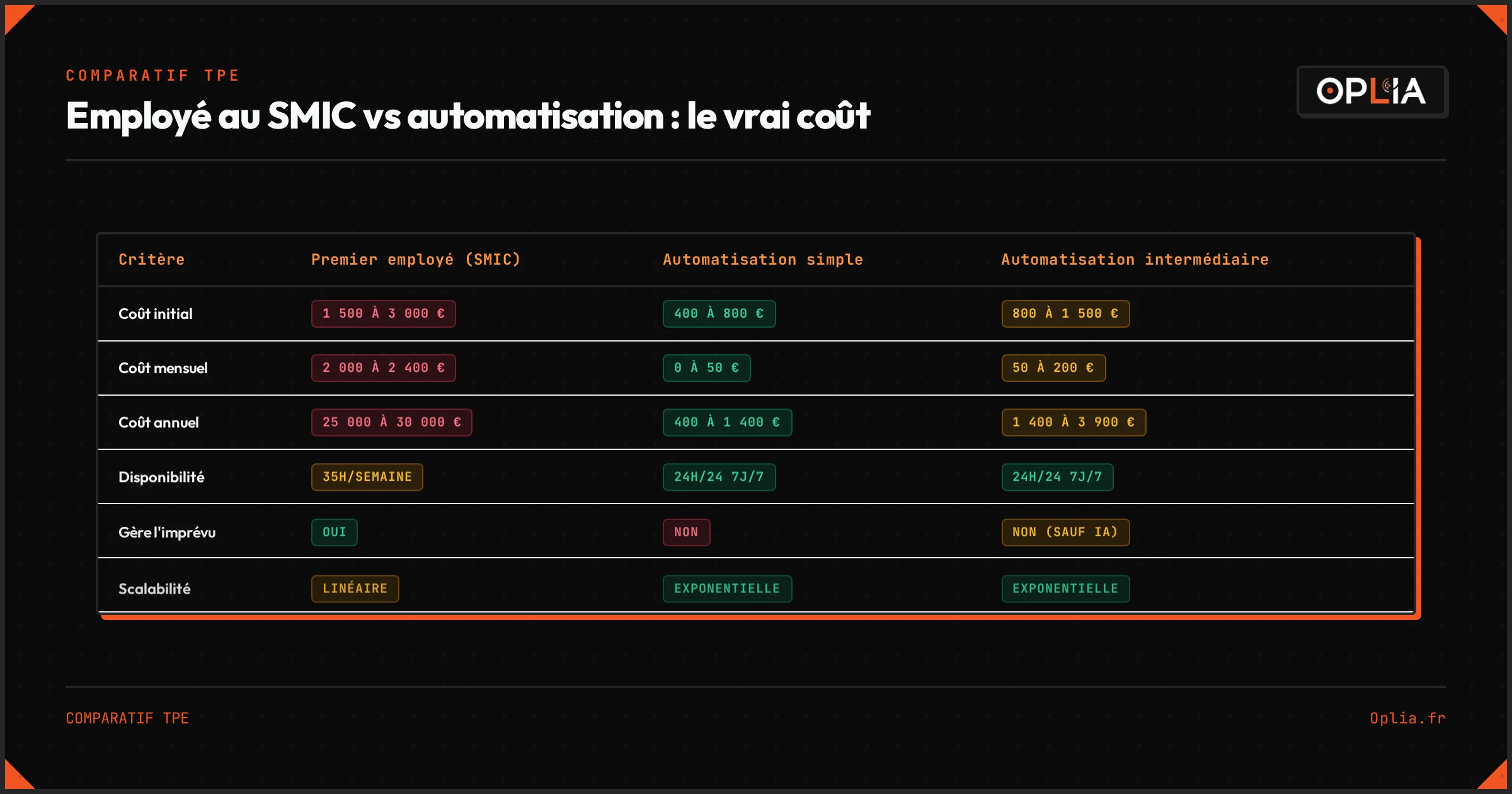
An objective comparison requires pitting setup costs and recurring fees against each other over a twelve-month period.
| Criterion | First employee (minimum wage) | Simple automation (1–2 workflows) | Intermediate automation (3–5 workflows) |
|---|---|---|---|
| Initial cost | €1,500 to €3,000 (recruitment + equipment) | €400 to €800 | €800 to €1,500 |
| Recurring monthly cost | €2,000 to €2,400 (salary + contributions) | €0 to €50 (server hosting) | €50 to €200 (maintenance + hosting) |
| Total annual cost | €25,000 to €30,000 | €400 to €1,400 | €1,400 to €3,900 |
| Availability | 35h/week (excluding vacations and leave) | 24/7, 365 days a year | 24/7, 365 days a year |
| Error rate | ~1–5% (human inattention) | ~0% (deterministic tasks) | ~0% (with optional human validation) |
| Volume scalability | Linear (1 employee = fixed capacity) | Exponential (same cost for 10 or 1,000 flows) | High |
| Handling the unexpected | ✅ Yes (situational intelligence) | ❌ No | ❌ No (requires escalation to a human) |
This table does not mean automation replaces an employee as a whole. It highlights that for low-value-added tasks, the cost gap makes automation the right move before a hire.
Three real small-business scenarios
Scenario 1: The independent consultant under administrative pressure (Revenue: €85,000)
He spends 12 hours per week on invoicing, tracking payments, and chasing client follow-ups. He is considering a part-time administrative assistant (around €1,200/month fully loaded). Solution: two accounting automation workflows for €800 setup and €50/month hosting. Result: 10 hours freed per week for an annual cost of €1,400, versus €14,400 for the part-time hire.
Scenario 2: The fast-growing heating equipment installer (Revenue: €190,000)
His quotes require an initial technical site visit and custom specifications. Full automation is impossible, but manual data entry slows down responses. Solution: automated generation of standard quotes and sizing calculations (saving 3 hours per job), combined with hiring a field technician. Automation lightens the role’s administrative burden so the employee can focus on jobsites. To go deeper on this case, discover how to close more deals without hiring.
Scenario 3: The online business facing support requests (Revenue: €320,000)
It receives 60 support messages a day, 65% of which are recurring requests (delivery tracking, return policies). Solution: automated routing with instant answers for standard cases and direct transfer of specific requests to the existing customer service team. The current team absorbs the entire flow without additional hiring.
How Do You Know If Your Business Is Ready for One or the Other?
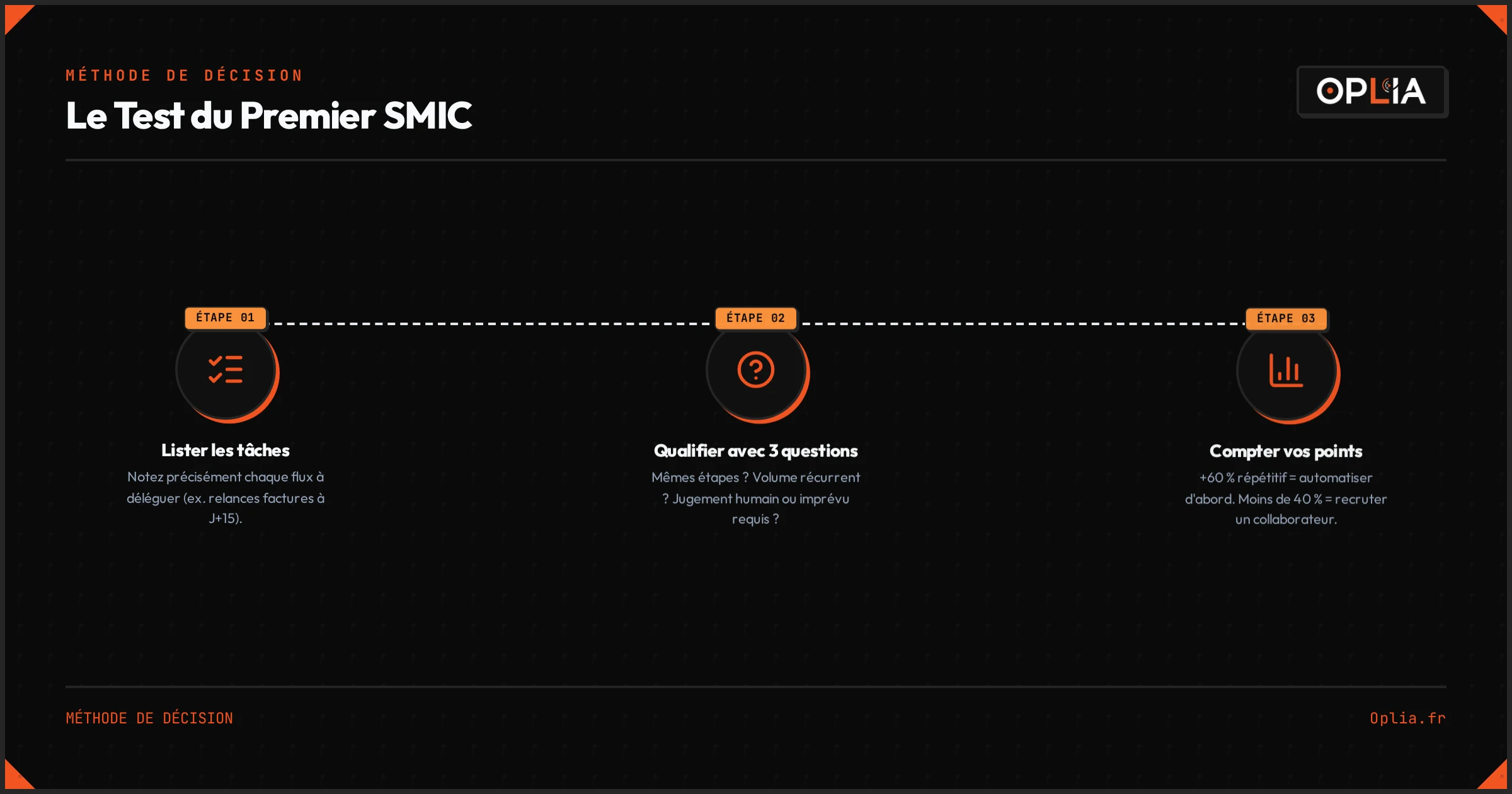
The First Minimum-Wage Hire Test lets you objectify your situation in 15 minutes on a sheet of paper.
Step 1: List the tasks to delegate precisely
Write down all the time-consuming tasks that eat up your time. Detail each action: write “chase invoices past due at D+15 and D+30” rather than “do the admin”.
Step 2: Assess each task against 3 key criteria
For each line in your list, answer yes or no:
- Does the process always follow the same logical steps? (yes/no)
- Is the information flow recurring and predictable? (yes/no)
- Does execution require human judgment or improvisation? (yes/no)
If you get yes / yes / no → automate first. The flow is mature enough for a software scenario. If you get no / no / yes → hiring is essential. The role requires human skills. Intermediate case → hybrid scenario. Automation prepares the elements, a human validates and finalizes.
Step 3: Calculate the split of your volume
| Proportion of tasks | Operational recommendation |
|---|---|
| More than 60% standardized tasks | Automate first. Your first hire will land in a healthy, productive structure. |
| 40 to 60% standardized tasks | Go for a mixed approach. Automate recurring flows and hire for high-relational or high-technical tasks. |
| Less than 40% standardized tasks | Hiring is the right answer. Still, document your procedures properly before the new employee arrives. |
Your scored decision checklist
| # | Framing action | Status |
|---|---|---|
| 1 | Build the exhaustive, precise list of tasks to delegate | ☐ |
| 2 | Qualify each task against the 3 criteria (stability, recurrence, judgment) | ☐ |
| 3 | Calculate the ratio of automatable tasks to human tasks | ☐ |
| 4 | Calculate the annual employer cost of a hire (€25,000 to €30,000) | ☐ |
| 5 | Estimate the cost of automating the identified recurring processes | ☐ |
| 6 | Validate flow stability before starting the technical setup | ☐ |
| 7 | Set a supervision and maintenance budget (€50 to €200/month) | ☐ |
How to read your score:
- 0 to 2 boxes checked: Exploration phase. Take the time to document your daily tasks before any financial commitment.
- 3 to 5 boxes checked: Advanced diagnosis. Complete the comparative costings to decide objectively.
- 6 to 7 boxes checked: Full framework. Your action plan is ready to deploy.
Key Takeaways
- A first minimum-wage employee is a €25,000 to €30,000 per year commitment, contributions and ancillary costs included. By contrast, automating targeted workflows requires €400 to €1,500 in initial setup.
- Automation prepares the ground for hiring. By removing repetitive administrative tasks, it lets your first hire be profitable from their first weeks on high-value work.
- The First Minimum-Wage Hire Test objectifies the decision in 15 minutes. If most of your recurring tasks are stable and require no improvisation, automation is the logical first step.
- Remaining the bottleneck of your own business is the most expensive cost. Postponing the structuring of your workflows slows growth and drains the owner.
At Oplia, we always map out the time-consuming processes in detail before starting any automation. If you are torn between hiring or automating your operations, a workflow diagnostic quantifies precisely how much time you can reclaim each week.
Going Further
- Automating administrative tasks to free up useful time: deploy your first operational workflows
- Automating unpaid invoice follow-ups: a use case that pays for itself within days
- Stop doing everything yourself without losing control of your business: structure and delegate with peace of mind
An employee can be replaced. A founder who gets their time back multiplies.
Need local support? Discover our service areas across France.