How to produce a month's worth of content in half a day?

The bottom line: A month’s worth of content doesn’t take a month. With a 4-step system — preparing briefs, generating drafts in batch, editing in one focused session, scheduling publication — half a day is enough to produce 4 to 8 articles that rank.
What you’ll learn:
- The 4-block, 2-hour system to produce a month’s worth of content without burning out
- How to prepare SEO briefs ahead of time so the production session is 100% fluid
- The AI workflows that turn batch writing into a productivity powerhouse
- The critical step that 90% of creators skip — and that kills their content performance
Before you continue: This article is aimed at small business owners who want to publish regularly without spending their evenings and weekends doing it. If you already have a 5-person editorial team, move along. If you’re alone or with an occasional collaborator and your site isn’t taking off due to a lack of fresh content, this method is for you.
Published on July 10, 2026 • Updated on July 10, 2026
I spent six months feeling guilty. Every Sunday evening, I told myself “this week, I’m publishing two articles.” Every Friday, the drafts/ folder had gathered dust. The problem wasn’t motivation — it was the method. Writing an article from start to finish, from idea to publication, is like building a house brick by brick without a plan: it takes three times longer than necessary and the result is never up to par.
The problem: Publishing regularly requires a writing discipline that most small business owners simply don’t have the time for. The result: the blog stagnates, SEO sputters, and competitors who are publishing take the top spots.
The solution: AI-assisted batch writing — four hours of focused work once a month, zero blank page syndrome, zero procrastination. You don’t write during the session: you edit, you enrich, you publish.
The proof: 96.55% of content published on the web receives no Google traffic (the full study). The problem isn’t Google — it’s valueless content, hastily written, with no strategy. The method I’m detailing here is the one I use for my own blog and for the small businesses I support. It produces content that ranks because it starts from a solid foundation, then receives the one thing AI can’t simulate: real-world, hands-on experience.
Why is batch writing the only viable method for publishing regularly?
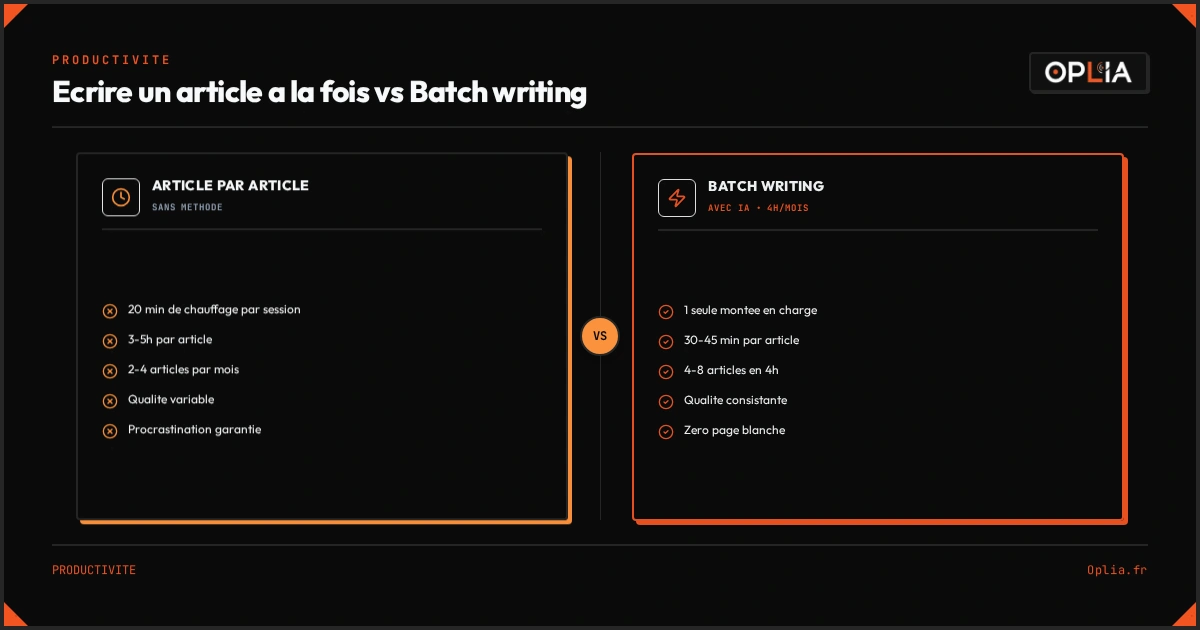
Writing one article at a time means reinventing the wheel every time. You spend 20 minutes getting back into the flow, 30 minutes looking for your notes, 15 minutes finding the right template. In a one-hour session, you’re left with 10 minutes of actual writing.
Batch writing reverses this ratio. By grouping all similar tasks together, you eliminate the “warm-up” time between each article. Research shows that the brain takes between 15 and 25 minutes to reach a state of deep focus on a creative task. If you write one article per session, you lose this ramp-up time every single time. If you chain four articles in a row, you only pay it once.
The best-documented case study on the subject comes from an SEO project that published 120 articles in 6 months. The pace: 20 articles per month, split into 15 supporting articles of 1,000 words and 5 pillar articles of 3,000 words. Result: the site went from 300 to 45,000 monthly visitors, and two years after stopping mass production, it reached 170,000 visits per month — with only 5 additional articles published in between. Consistency and thematic coherence did the work.
What I learned in the field: The first time I tried batch writing, I spent 3 hours on the first article and 45 minutes on the fourth. The difference? On the first one, I was still thinking about structure, tone, and format. By the fourth, I was in the flow — my brain had internalized the pattern and was just executing it. That’s exactly why batching works: you only pay the cognitive startup cost once.
| Method | Time per article | Articles per month | Perceived quality |
|---|---|---|---|
| Isolated writing (1 article/session) | 3-5 hours | 2-4 | Variable — depends on the day’s inspiration |
| Batch writing without AI | 1h30-2h30 | 6-10 | Consistent — pattern internalized |
| AI-assisted batch writing | 30-45 minutes | 8-16 | High — the freed-up time goes into human editing |
How to prepare your production half-day so you don’t waste a single minute?
The production half-day is a sprint. If you spend the first 45 minutes looking for topic ideas, you’ve already lost. Preparation happens ahead of time, ideally the day before or the previous weekend, in a dedicated one-hour session.
Here’s what your production kit should contain, ready before D-Day.
The briefs folder
Each brief fits on a single card and contains five pieces of information:
- The primary keyword and its long-tail variant — found via Google Keyword Planner (free), Ahrefs, Semrush, or simply by typing your topic into Google and looking at search suggestions
- Search intent — is the person typing this keyword looking to learn, compare, or buy? The answer determines the article format
- The 3 to 5 H2s — the sub-questions the article must answer, phrased as natural questions (e.g., “What budget should I plan for installation?” rather than “Installation budget”)
- The 2-3 competing articles already ranking on that keyword, with a note on what they’re missing (the angle you’ll cover that they ignore)
- Your hands-on experience — an anecdote, a mistake made, a result achieved. This gem is what will differentiate your article from the 96% of web content that gets no traffic
Tip: The “phone note + one-hour Sunday session” method is the most effective for maintaining a flow of ideas. Every time a client asks you a relevant question, jot it down in a dedicated file. On Sunday, turn those questions into briefs. You’ll always have 10-15 briefs ready and will never run out of ideas on production day.
The ready-to-use tool stack
| Tool | Role | Cost |
|---|---|---|
| Claude or ChatGPT | Draft generation | €0-20/month |
| Google Docs or Notion | Editing and storing briefs | €0 |
| Google Keyword Planner | Keyword research | €0 |
| Grammarly or Antidote | Spell checking | €0-15/month |
| n8n (optional) | Automating the brief → draft pipeline | €0-20/month |
The bare minimum: an LLM and a briefs document. Budget: zero euros.
What are the 4 work blocks that structure the half-day?
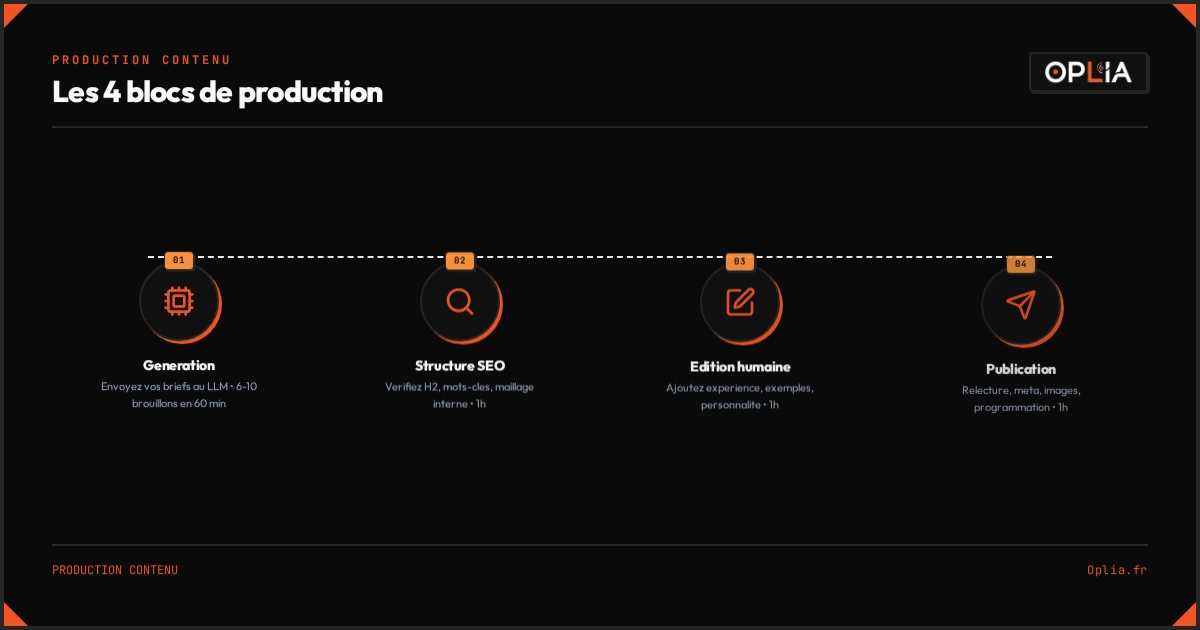
The production half-day breaks down into four one-hour blocks. Each block has a single objective and a precise list of actions. No multitasking, no scattering.
Block 1 — Generation (1h)
During this hour, you don’t write anything. You send your briefs to the LLM and collect the drafts. The secret is having a well-honed prompt template that produces actionable results on the first try.
Here’s the prompt I use:
“You are an SEO writer specialized in [my industry]. Write a structured blog article based on the following brief. Rules: H2s as natural questions, paragraphs of 2-4 sentences, tables when relevant, direct and concrete tone. Length: [X] words. Add a 3-question FAQ section at the end. Do NOT write the conclusion — I’ll write it myself.”
Run this prompt for each brief, collect the drafts in a folder. Don’t even read them yet — editing comes in Block 3. The goal is to have 6 to 10 raw drafts in 60 minutes.
What I learned in the field: The first time, I spent 20 minutes fine-tuning each prompt, rewriting briefs, hesitating over tone. Result: 2 drafts in an hour. The key is having ONE prompt template, ONE brief format, and applying them without thinking. Personalization comes at the editing stage — not at generation.
Block 2 — Structure and SEO (1h)
You have your drafts. Before editing, verify that the structure is solid. A well-structured draft with a neutral tone can be fixed in 15 minutes of editing. A perfectly-toned draft with poor structure will take 2 hours to correct.
Check for each article:
- The H1 contains the primary keyword and reads like a natural question
- All H2s are questions (ending with ”?”) that a human could type into ChatGPT
- Paragraphs are 2 to 4 sentences maximum
- Visual structure is respected: 10-15% tables, 20-30% lists, 50-60% paragraphs
- Secondary keywords appear naturally in H2s and opening paragraphs
- Internal linking is planned: 3-4 links to other articles on your site
This is also the moment to add data that only you possess: real numbers, client results, screenshots from your dashboard. These elements are impossible for AI to generate and constitute your competitive advantage.
Block 3 — Human editing (1h)
This is the critical block. This is where content goes from “decent AI draft” to “content that ranks and converts.”
What you must imperatively add to each article:
- Your personal experience — an anecdote, a lesson learned, a failure you drew something from. This narrative block can only come from you.
- Concrete examples from your industry — replace the draft’s generic examples with real cases you’ve experienced.
- Original data — if you have figures from your business, client results, observed trends, now is the time to integrate them.
- Your voice — rewrite transitions, add your personality, remove AI language tics (“in conclusion,” “it is important to note that,” “nowadays”).
The study conducted across 73 blog sites and 89 SEO experiments confirms it: 60% of sites using AI content tanked, 40% took off. The difference? The 40% applied rigorous human editing with sourced real data and a reading-optimized structure.
| What AI does well | What you must do |
|---|---|
| Structuring an article logically | Adding your hands-on experience |
| Respecting keyword density | Replacing generic examples with real cases |
| Generating H2 variants | Injecting your personality into transitions |
| Proposing a coherent FAQ | Verifying every factual claim |
| Suggesting internal links | Adding original data that only you possess |
Block 4 — Publishing and distribution (1h)
The final block turns your articles into assets that work for you.
- Final proofreading — a spelling and grammar pass. Read the first and last paragraph aloud: that’s what the reader scans most attentively
- Meta description — 120 to 155 characters, active voice, concrete benefit
- Clean URL — 3 to 6 words, no stop words (no “the,” “a,” “for”)
- Images — one header image per article, at least one screenshot or infographic in the body
- Scheduling — space publications 3 to 7 days apart rather than publishing everything at once. Google prefers regularity
- Social media excerpts — for each article, prepare a 5-line LinkedIn post that makes people want to click
How to use AI to accelerate without losing quality?
AI is an accelerator, not a replacement. Used correctly, it divides production time by three. Used as a publishing machine without editing, it sends you into the 60% of sites that tank.
The right approach: AI = first draft, not final version
Of the 73 sites analyzed in the generative AI comparative study, one finding is unequivocal: Claude outperforms ChatGPT for blog content generation. Articles generated by Claude require less rewriting and produce structures closer to what Google values.
But the model used is secondary to the method. What really matters:
- Answering search intent in the first viewport — the reader must understand in 5 seconds that they’re in the right place
- Using real data, not AI-invented statistics — Google detects and penalizes synthetic data
- Creating original visuals — real screenshots, infographics based on your data, not generic illustrations
The “publish and pray” trap
Publishing an AI draft without editing is playing Russian roulette with your SEO. The pattern is documented: sites that abuse unedited AI content follow a mountain-shaped curve — rapid growth, peak, then brutal decline. Lily Ray’s study of over 220 sites shows that 54% of sites using unedited AI content lost at least 30% of their traffic, and 22% lost more than 75%.
The decline isn’t immediate — it usually comes 3 to 6 months after mass publication. The time it takes Google to reassess the site as a whole and apply scaled content abuse penalties. At that point, the damage is done and recovery takes months.
“AI is an excellent assistant for analyzing and structuring. It does not replace human judgment on what is useful to your audience.” — John Mueller, Search Advocate at Google
What are the traps that turn your batch into garbage content?
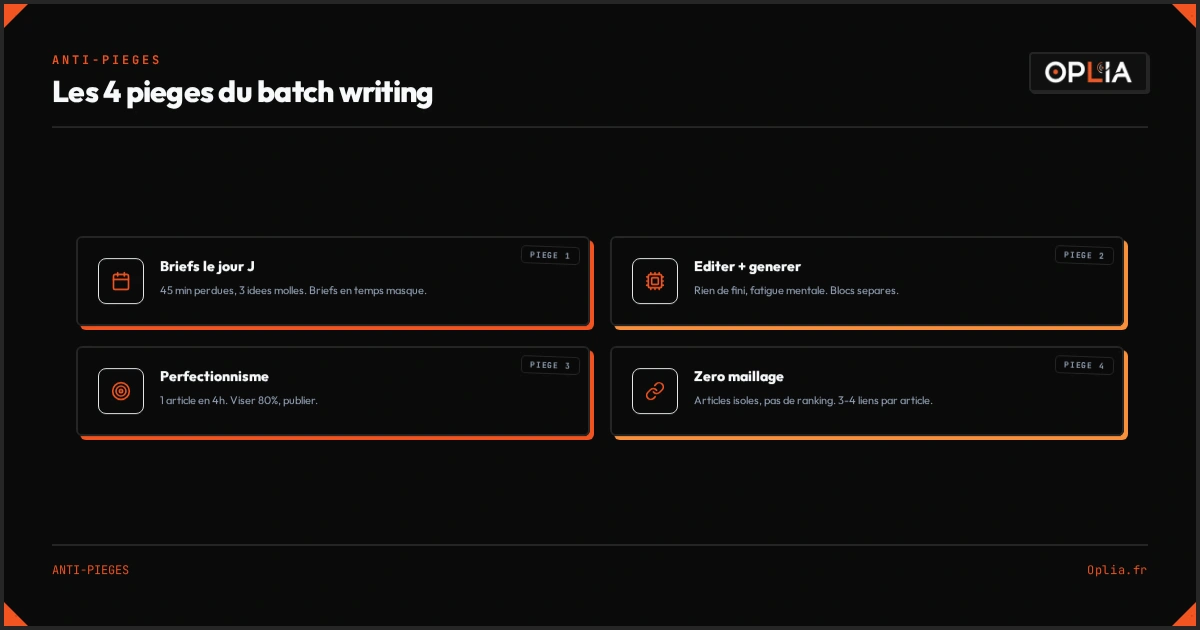
After applying this method dozens of times for my own content and my clients’, here are the four traps that systematically kill batch writing sessions.
Trap 1: Preparing briefs on the same day
This is the number one trap. You show up motivated for your half-day, open a blank document, and start looking for topic ideas. An hour later, you have three shaky ideas and frustration is mounting.
The solution: Briefs are prepared in hidden time — during commutes, between appointments, on Sunday mornings. One idea = one note in your phone. On production day, you have 15 briefs ready. Zero time wasted.
Trap 2: Editing while generating
Switching between the ChatGPT prompt and rewriting the previous paragraph is the best way to finish nothing. Your brain constantly shifts from “instruction giver” mode to “critical editor” mode — two incompatible mental states.
The solution: Respect the strict separation of blocks. Block 1 = pure generation, without reading. Block 3 = pure editing, without regenerating. Your brain will thank you.
Trap 3: Wanting 10 perfect articles
Setting a goal of 10 flawless articles in 4 hours is condemning yourself to finishing zero. Perfectionism is the enemy of batch writing — you spend 45 minutes on the first article and have no energy left for the rest.
The solution: Aim for 80% quality, not 100%. An article at 80% published is infinitely more valuable than an article at 100% sleeping in your drafts. Perfection will come with experience, not with a marathon session.
Trap 4: Neglecting internal linking
You have 8 articles ready, you publish them, and… nothing. Each article lives in isolation, with no links to others, no structure guiding Google from one page to the next.
The solution: Internal linking is the most underestimated force multiplier in content SEO. In the case study of 120 articles in 6 months, the site did zero manual backlinking — only 3 to 4 internal links per article. Result: 170,000 monthly visits. Every article you publish must link to at least 2 existing articles and be linked from at least 2 others.
| Trap | Symptom | Fix |
|---|---|---|
| Briefs prepared on D-Day | 45 min wasted, 3 weak ideas | Briefs in hidden time, 15 ready before session |
| Simultaneous editing + generation | Nothing finished, mental fatigue | Separate blocks: generation then editing |
| Perfectionism | 1 article in 4 hours | Aim for 80%, publish, iterate |
| Zero internal linking | Isolated articles, no ranking | 3-4 internal links per article, systematically |
How to adapt this method to your industry and your pace?
The 4-block method is a framework, not a straitjacket. Here’s how to adapt it based on your profile.
You’re a craftsman or shopkeeper
Your strength: you have hands-on expertise that no one can copy. Your clients ask you questions every day — each question is a brief.
Adaptation: Reduce volume to 3-4 articles per month, but invest more time in Block 3 (human editing). Your articles need to smell like the workshop, the job site, the client interaction. AI gives you the structure, you add the sweat.
You’re a consultant or B2B service provider
Your strength: you know your clients’ problems better than they do. Content is your primary prospecting lever.
Adaptation: Structure your articles around disguised case studies. The brief systematically includes a real client problem, the solution you provided, and the quantified result. AI generates the article, you replace generic examples with your concrete cases. One article published per week = a running pipeline of prospects.
You only have one morning every two months
Adaptation: Switch to a bimonthly pace but with longer, denser articles (2,500-4,000 words). Prepare 15-20 briefs over the two months, then produce 6-8 pillar articles in one morning. Schedule them over 8 weeks. You maintain weekly publishing without thinking about it.
Checklist — your action plan
- Create a briefs file and note down 10 client questions this week
- Define your AI prompt template (just one, that you’ll use for all articles)
- Block a half-day in your calendar for the first batch writing session
- Prepare your briefs the day before (not on the day itself)
- During the session, strictly respect the 4 blocks without spilling over
- After publishing, track performance in Google Search Console
- Iterate: adjust the prompt template and brief structure based on results
Key takeaways
- Batch writing is the only viable method for publishing regularly without spending your life on it — 4 hours a month is enough for 4 to 8 articles, provided you don’t write but edit
- Preparation accounts for 50% of the result — briefs ready ahead of time, a well-honed prompt template, and the production session becomes a fluid sprint with no blank page
- AI accelerates, humans differentiate — without human editing (hands-on experience, real data, personal tone), your content joins the 96% that receives no traffic
- Internal linking is free and underestimated — 3 to 4 links per article, that’s the only lever that propelled a site to 170,000 visits without any manual backlinking
If you apply this method once a month for six months, you’ll have between 24 and 48 articles working for you 24/7. The question isn’t whether you can afford to — it’s whether you can afford not to.
To go further
- AI-generated content: will Google penalize you? — Google’s official rules and how to stay compliant
- 5 AI automations to save 10 hours a week in your small business — the logical next step: automating what takes your time beyond content
- Automate your administrative tasks in 2 hours — the n8n workflow to connect your tools without coding
Content isn’t what’s missing. What’s missing is a system that produces it without draining you.
Need local support? Discover our service areas across France.