Are guest articles on other sites still worth it?

The essentials: Guest articles remain a powerful lever, but their purpose has changed profoundly. We no longer look for a simple free link, but for direct access to a qualified audience and a gain in visibility with AI engines.
What you will learn:
- Why guest blogging is not dead, despite the repeated warnings since 2014
- What a guest article really brings in 2026, far beyond the simple link
- When the investment is worth it for a small business, and when to avoid it
- The 5-step method to land an article without looking like a spammer
Before you continue: This article is for small business owners and freelancers who already have a website and want to broaden their visibility. If your site suffers from basic technical errors or is not properly indexed on Google, start by cleaning up those foundations. A guest article will never save a failing site.
In 2014, Matt Cutts, then head of Google’s webspam team, published a text that became famous: guest blogging is dead. Twelve years later, agencies still send hundreds of emails to land an article on a third-party site. Who is wrong?
The problem: Many businesses spend enormous energy writing for external blogs without knowing whether the approach generates any return on investment.
The solution: This article gives you the concrete criteria to decide, in one read, whether guest posting is a profitable investment for your business.
Table of contents
- What is a guest article, and why is it said to be dead?
- Do guest articles still help Google rankings in 2026?
- What does a guest article bring beyond a simple link?
- When is a guest article worth it for a small business?
- How to land a guest article without looking like a spammer?
- How to know if your guest article worked?
- What to remember
- Go further
What is a guest article, and why is it said to be dead?
Within an SEO and visibility strategy, a guest article consists of writing a text for another site’s blog, with your byline and usually a link to your own site. This approach is also known as a guest post or guest blogging. The practice is old, and for years it was the go-to method for getting links.
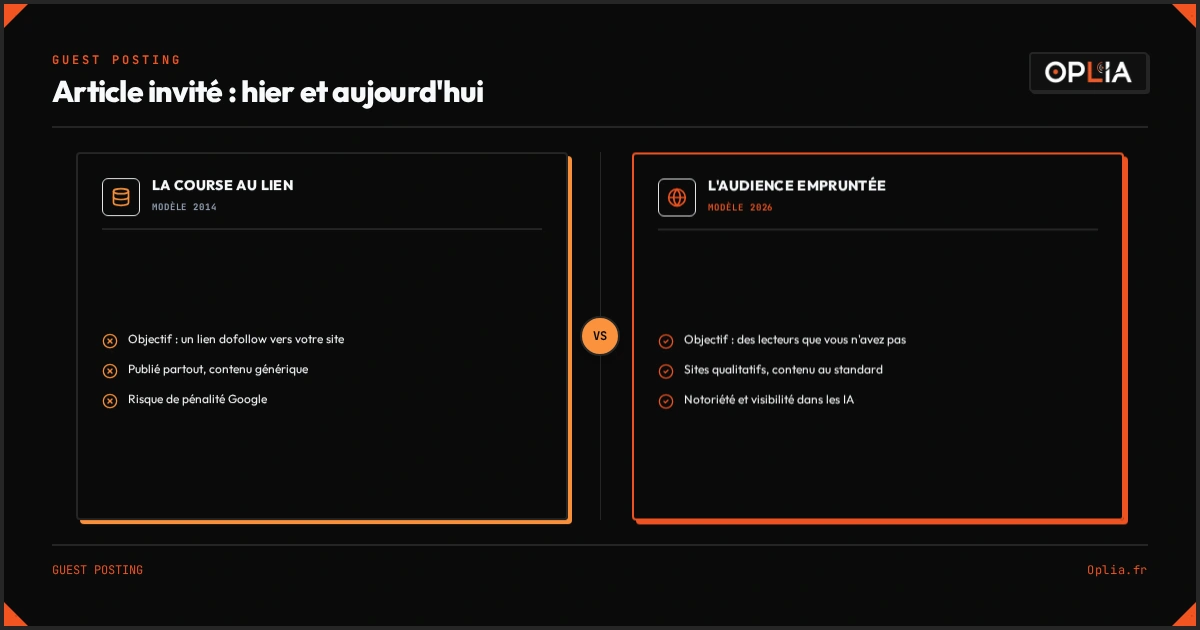
What Matt Cutts condemned in 2014 was the industrial version of the guest article. Thousands of mediocre texts, written on an assembly line, with over-optimized anchor texts and published on any site accepting paid or automated submissions.
“If you’re using guest posting as a way to gain links, you should probably stop. Over time it’s become a more and more spammy practice.” — Matt Cutts, former head of Google’s webspam team — The decay and fall of guest blogging for SEO
Rand Fishkin, co-founder of Moz, described what he calls the slippery slope in his video analysis on the subject. It all starts with a quality contribution on a respected site. Then comes the search for a second link, then a third. Standards gradually drop, the process gets automated and ends up producing texts ignored by readers, until the algorithmic penalty.
“I’d much rather have a great guest post that either doesn’t link to me, or links to me with nofollow, if I know 5,000 or 10,000 people are going to read it.” — Rand Fishkin, co-founder of Moz — Moz’s video analysis of the guest blogging slippery slope
The conclusion is clear: the principle of the guest article is not the problem, it’s its quantitative abuse that has been neutralized.
Do guest articles still help Google rankings in 2026?
Yes, but the mechanism has become more subtle. The link still plays a role in the algorithms. In its analysis, Semrush’s study on ranking factors reminds us that the diversity of referring domains and the real traffic received by linking pages are among the major trust signals.
The major change comes from publishers. Most high-authority sites now refuse dofollow links in external contributions, or no longer accept occasional writers. Yet an article without a direct link can retain a very high commercial and reputational impact.
The rise of generative search engines has accelerated this transition. During an expert panel at WordCamp Europe 2026, reported by Search Engine Journal, specialists stressed that brand mentions were becoming a key signal for AI SEO: “Brand is the new backlink,” summed up Pam Aungst Cronin, an SEO consultant. AI models prioritize the entities they frequently identify within recognized editorial ecosystems.
For a small business owner, the rule is clear: the link offers technical support, but brand authority brings more lasting reach. The guest article primarily serves to build that reputation, as we detail in our guide on E-E-A-T explained to small businesses.

To assess the overall relevance of your visibility investments, you can also read our analysis: does SEO really work in 2026?.
What does a guest article bring beyond a simple link?
That’s the real operational question, because the lasting value lies in the audience. We call this the Borrowed Audience Rule.
The Borrowed Audience Rule: when you publish on a third-party site, you temporarily borrow its readership, its trust capital, and its qualified traffic. The first question to ask yourself is “did I leave with qualified readers?”, well before “did I get a link?”.
Concretely, a well-targeted guest publication generates four measurable outcomes:
| What it brings | What it translates to | Does the link matter? |
|---|---|---|
| A qualified audience | Prospects discover your expertise | No, referred traffic is enough |
| Professional credibility | Your brand is associated with recognized publications | No |
| Visibility in AI engines | Top-tier sites feed ChatGPT and Perplexity answers | Indirectly |
| An E-E-A-T authority signal | Search engines associate your expertise with a trusted source | Yes, if the link is granted |
A telling example: Semrush’s guest blogging case study documents the case of Dana Nicole, a freelance writer, who generated nearly 400 email subscribers in 11 months through her contributions published on the Buffer blog. The link was secondary; it was the borrowed audience that created all the value.
It’s also a lever to appear in AI-generated answers. Businesses mentioned on top-tier platforms are more spontaneously picked up by conversational assistants. We explain these mechanisms in our guide: how to make my brand appear in ChatGPT.
When is a guest article worth it for a small business?
The direct answer: rarely at the start, and very useful once the foundations are in place.
What I learned in the field: Valentin, a landscaper in Buzet-sur-Tarn, arrived with a WordPress site with 2 indexed pages and a Google profile that was nowhere to be found. He wanted to “be the number one in Toulouse”. I started with his Google profile and his 30 city pages, before talking about links. It’s that local base that generated his first jobs.
In the field, small businesses get their first commercial results without complex link building: an optimized business profile, targeted local listings, verified customer reviews, and a quick technical foundation. Press relations or guest articles come into play in a second phase.
The other decisive factor is opportunity cost. Writing a high-quality guest article requires, according to Semrush’s guide to guest blogging, between 10 and 15 hours of work: identifying partners, reaching out, negotiating the angle, in-depth writing, and editorial back-and-forth. For a small business owner valuing their time at €50 to €100 per hour (or outsourcing the writing for €400 to €800), the investment represents €500 to €1,500 per publication. Investing that money when your business profile lacks reviews or your site loads slowly is a pure waste of resources.
The table below summarizes the priorities:
| Your business situation | Should you invest in guest articles? |
|---|---|
| Your site is not yet well indexed on Google | No. Fix the technical infrastructure first |
| Your Google profile is incomplete or has no recent reviews | No. It’s your number one business priority |
| The technical foundation is clean and the local profile is active | Yes, to reach an audience beyond your direct area |
| You have a study, data, or a unique experience to share | Yes, it’s the most effective angle to get accepted |
| You only want a quick artificial link | No. You’re wasting your time and budget |
To strengthen your local foundations before any external outreach, check out our file on the pillar of local SEO.
How to land a guest article without looking like a spammer?
The method rests on three simple but rigorous principles:
Rule 1: establish contact before pitching. Sending cold, generic emails produces a massive rejection rate. Interacting with the target publication’s posts, sharing its content, and commenting with relevance creates a first natural point of contact.
Rule 2: propose an original angle. First analyze about ten articles on the target blog to identify blind spots. If the topic has already been covered three times, your pitch will be rejected.
Rule 3: maintain a maximum editorial standard. Your article must match or exceed the usual quality of the host publication. Editorial teams spot superficial or sloppy content in seconds.
Here is the complete process, from initial contact to measuring the outcomes:
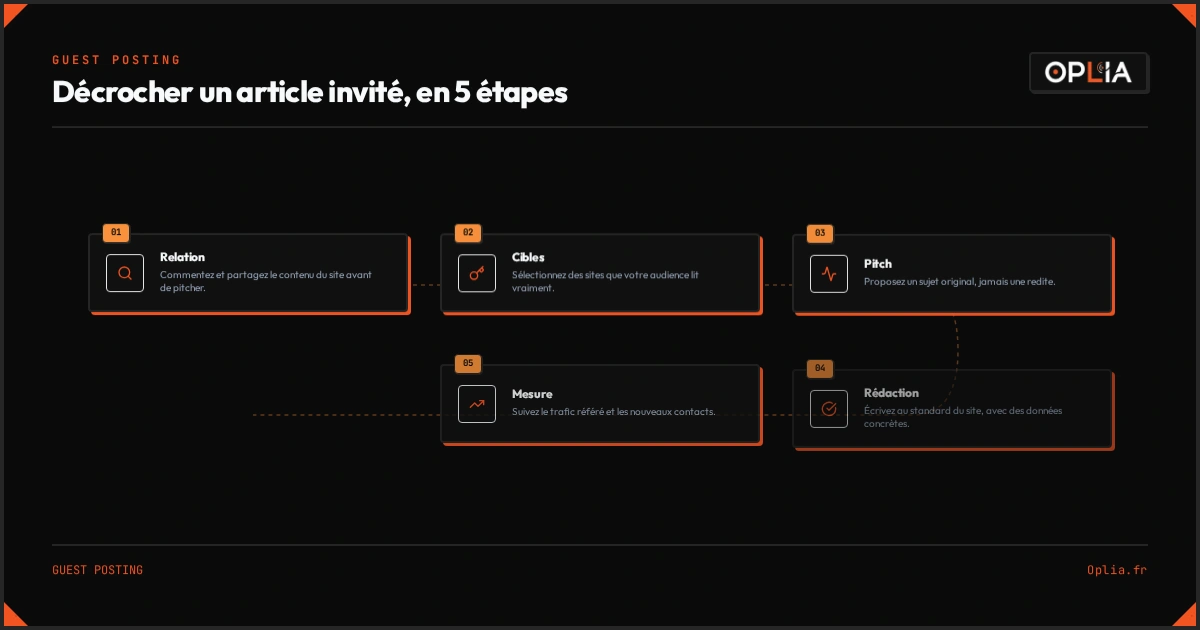
- Analyze 10 recent articles from the target publication to spot already-covered topics
- Interact with the site’s posts and authors for several weeks
- Define 2 or 3 original editorial angles backed by concrete data
- Write a personalized pitch demonstrating your understanding of their readership
- Produce a complete text that meets the partner’s format and substance requirements
- Proofread, integrate editorial feedback, and engage in the comments section after publication
- Measure referred traffic, sign-ups, and brand mentions obtained
Evaluation checklist before launching:
| # | Prerequisite action | Done? |
|---|---|---|
| 1 | My site is technically sound and my Google profile is optimized | ☐ |
| 2 | I selected a partner site that my target customers consult | ☐ |
| 3 | I initiated an exchange or identified a clear value proposition | ☐ |
| 4 | My topic brings an original perspective without repeating existing content | ☐ |
| 5 | I set up tracking for referring traffic and generated leads | ☐ |
Interpreting your score:
- 0 to 2: Don’t launch a guest article campaign. Focus your resources on your local visibility and your site’s conversion.
- 3 to 4: You’re on the right track, but strengthen the missing point before reaching out to editors.
- 5: You’re ready. Your foundations are solid and your contribution will bring a tangible return on investment.
How to know if your guest article worked?
The success of a guest publication is not measured by the sheer volume of links obtained, but by the concrete outcomes generated with the borrowed audience.
Three key indicators measure the real impact: the volume of qualified referring traffic to your site, the number of inquiries or newsletter sign-ups, and spontaneous mentions of your brand on other platforms. An article published on a reputable site that brings no visitors or leads has not paid back the 15 hours invested.
Conversely, a contribution that generates thousands of reads and qualified shares retains major value, even with a nofollow link. Rand Fishkin reminded us in his analysis for Moz: content read by thousands of qualified professionals produces more commercial impact than an isolated dofollow link on a domain without an audience.
The approach therefore requires a clear goal from the start: are you aiming for qualified traffic acquisition, building your professional authority, or brand association? Without a precise indicator, the effort remains hard to monetize.
What to remember
- The guest article remains a powerful lever: Google has sanctioned spammy automation since 2014, but values authentic editorial contributions.
- Audience beats the link: The value lies in the borrowed audience, brand authority, and visibility in AI engines.
- Timing is decisive for a small business: Prioritize your site’s technical health, your customer reviews, and your local presence before investing 10 to 15 hours per publication.
- The relationship determines the result: Engage with the target publication beforehand, propose an exclusive angle, and deliver content up to the standard of the best publications.
To identify serious providers and avoid artificial link networks, read our guide: how to delegate your SEO without getting ripped off.
A guest article does not replace your website. It makes it known.
Go further
- Does SEO really work in 2026?: the essential pillars of modern SEO
- Is SEO dead with artificial intelligence?: the real impact of AI engines on your visibility
- Do you really need to write 2,000-word articles?: why relevance beats raw length
Need local support? Discover our service areas across France.